 Jira & Confluence




 Bitrix24
Njangi · rules and regulations · Excel book
Njangi rules and regulations — with the table of turns and a contributions book, ready to print
Short answer. The number of members, the contribution and how often you meet: you see the pot, the date of your turn and what you pay before and after it. Pot: number of members × contribution per meeting (Arithmetic).
- Get the contribution and common fund ready — the day beforetype the date
- Sign the book when you take the pot — on the daytype the date
Check your own case.
Reminders for your group. The real dates are the ones your executive fixes.
Start typing right in the document — no sign-up. It stays in this browser; save it to your free Layers account to keep it, open it on your phone and share it.
Your njangi · the pot and your turn
When you take the pot, how much — and what you pay before and after
The number of members, the contribution, how often you meet, the first meeting and your turn. You see the pot, the date of your turn, your savings before it and what the group advances you — and an Excel njangi book with the table of turns and the contributions grid.
- Have every member sign the rules and regulations at the first meeting.
- Write down the order of turns: the dates fill in by themselves in the Excel file.
- At each meeting, tick the grid and have the beneficiary sign.
Arithmetic: pot = members × contribution; your date = first meeting + (turn − 1) × days between meetings; before your turn = (turn − 1) × contribution; after = (members − turn) × contribution. Dates count in fixed days. Not financial advice.

Lida, Layers template assistant
How many members, how much and how often — and I'll tell you when you take the pot.
The rules and the contributions book are ready to print.
Deadlines
The rules, with the source
| What | Deadline | Source |
|---|---|---|
| Pot | Number of members × contribution per meeting | Arithmetic |
| Date of your turn | First meeting + (turn − 1) × days between meetings | Arithmetic |
| Before your turn | (Turn − 1) × contribution: your savings | Arithmetic |
| After your turn | (Members − turn) × contribution: the group advances it to you and you keep paying | Arithmetic; rules, rule 7 |
| Common fund | Members × common fund per meeting over one cycle | Your njangi's rules |
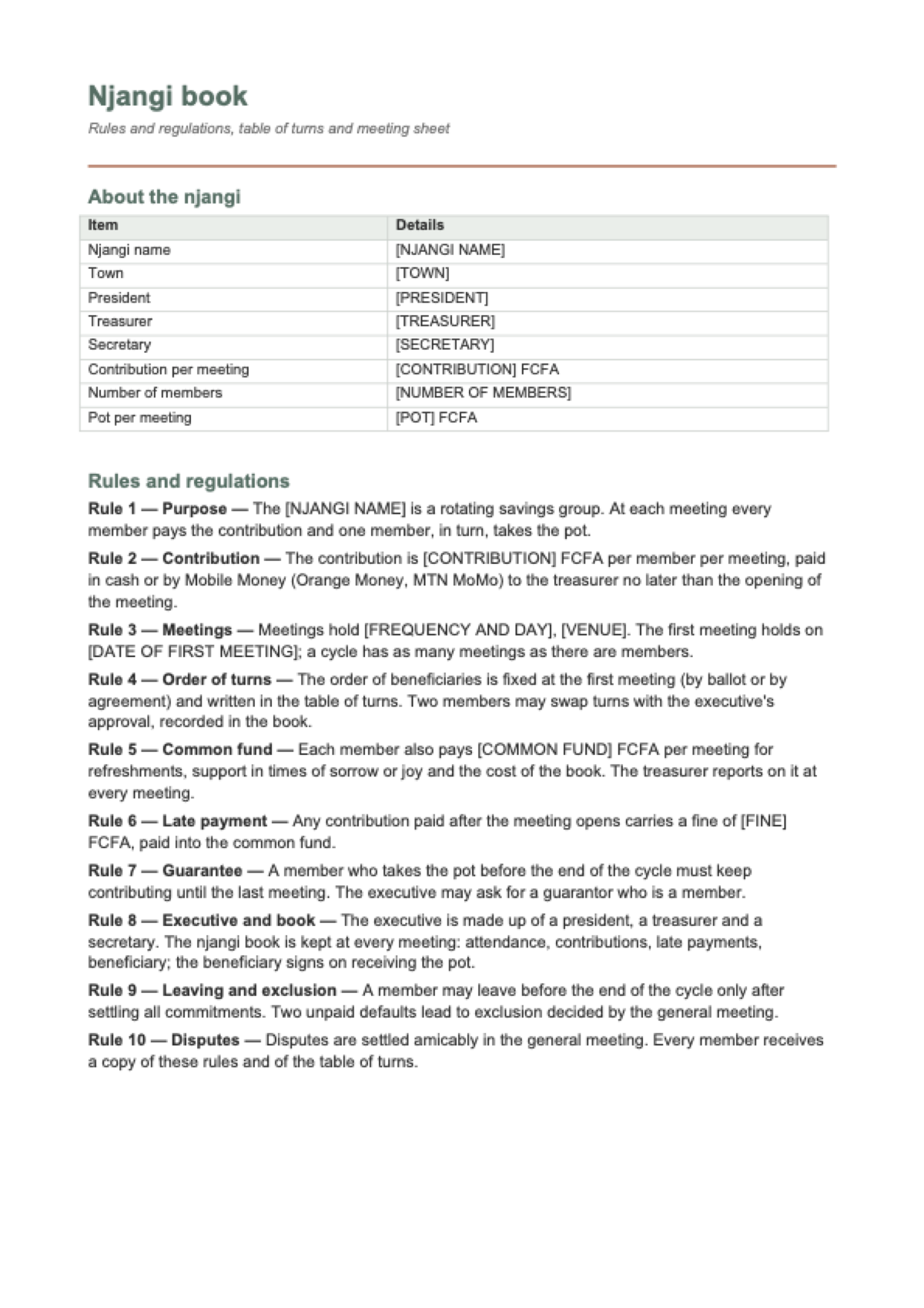
A njangi is run by its members: the book gives a set of rules to adapt (contribution, late payment, guarantor, exclusion) and to have everyone sign.
Step by step
What to do, in order
1
Agree the rules
Contribution, frequency, venue, common fund and the fine for paying late — the rules are ready, just fill them in.
2
Draw the turns
Write down the order of beneficiaries: the dates fill in by themselves in the Excel file.
3
Keep the book
At each meeting tick ✓ or R in the grid; the amount collected shows under every meeting.
Questions
What goes into njangi rules and regulations?
The amount and deadline of the contribution, how often and where you meet, the order of turns, the common fund, fines for late payment, the duty to keep paying after you have taken the pot, a guarantor, leaving and exclusion. The Word template has ten rules ready to adapt.
How do I work out the pot and my date?
Pot = number of members × contribution. With 12 members at 50,000 FCFA, each takes 600,000 FCFA. Your date = first meeting + (turn − 1) × interval: turn 5, meetings every 28 days from 2 August 2026 → Sunday 22 November 2026.
How do I keep a njangi book?
One line per member and one column per meeting: tick ✓ when paid on time, R when paid late. The Excel book counts the payments and the amount collected at each meeting; the table of turns has a column for the beneficiary's signature.
What if we meet on the first Sunday of the month?
The calculator counts in days (7, 14 or 28). For fixed monthly dates, just correct the dates on the 'Turns' sheet of the Excel file.
Is it free? Do I need to sign up?
It’s free and you don’t need an account: fill it in, calculate and download. With a free account you can save a copy to your Layers and come back to it later.
Other documents
Keep the papers in one place
Letters, receipts and notices in one folder you can share with family or a lawyer. The templates and the editor are free; Layers is free for up to 20 people.
A model set of rules between individuals, not legal or financial advice.