 Jira & Confluence




 Bitrix24
Ekub · rounds · Ethiopian calendar
Ekub savings tracker — the pot, your turn and who has paid, in birr
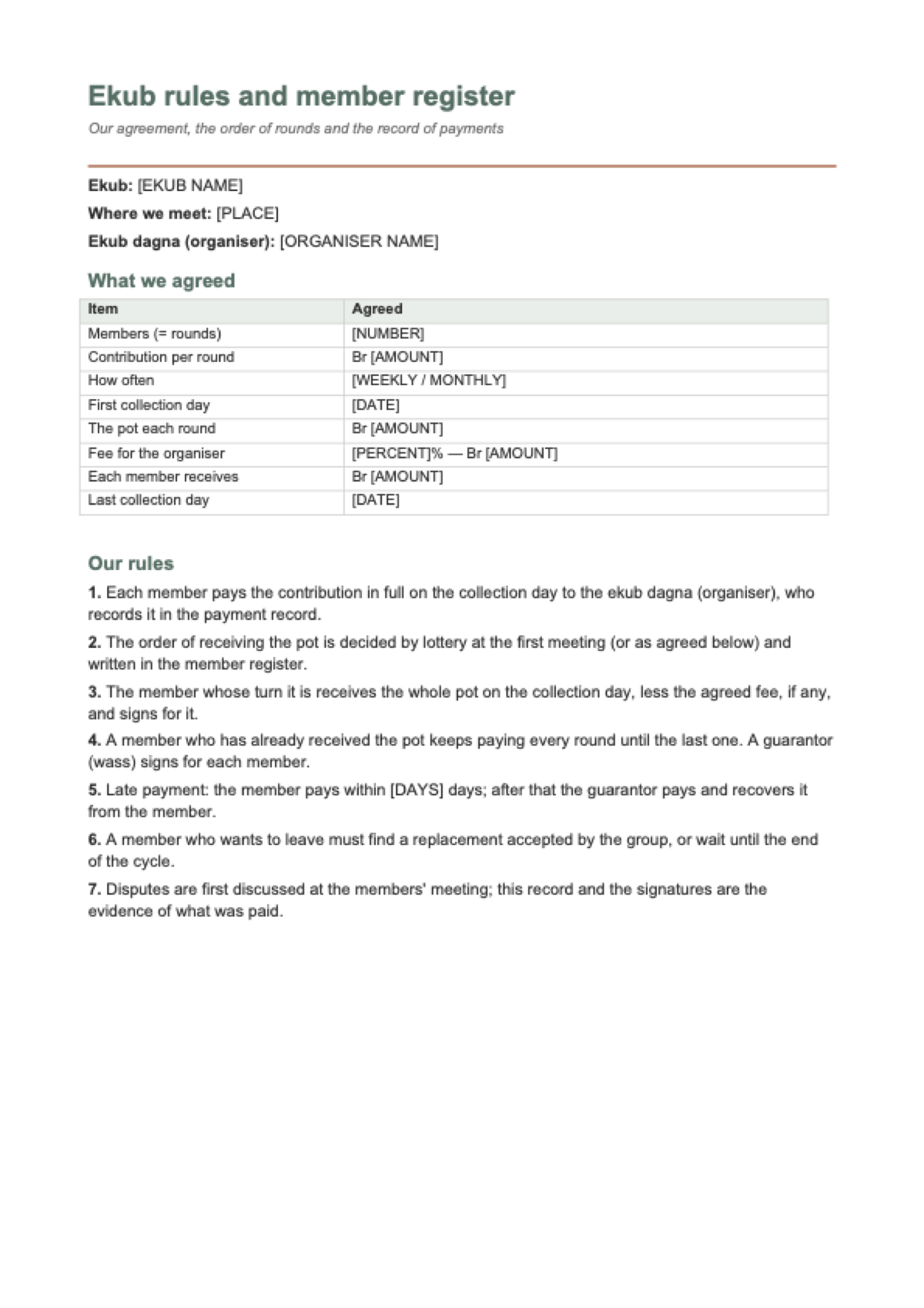
Short answer. Enter how many members, the contribution and your turn: you see the pot, what you receive and how much you have paid by then — and get the rules, the round dates and a payment record to print. The pot: members × contribution, every round (How an ekub works).
- Meet, agree the rules and draw the order — a week beforetype the date
- Collect guarantors' (wass) signatures — 2 days beforetype the date
Check your own case.
Tips, not rules: every ekub agrees its own.
Start typing right in the document — no sign-up. It stays in this browser; save it to your free Layers account to keep it, open it on your phone and share it.
Your ekub
The pot, your turn and its date — and what you have paid by then
Members, the contribution, how often and your turn. You see the pot, what you receive, what you have paid by your turn and what is left — and download the rules, the order of rounds with Ethiopian dates and a payment record.
- Agree the rules at the first meeting and draw the order of rounds; write it in the member register.
- Ask each member for a guarantor (wass) who signs next to their name.
- Tick every payment in the record on collection day — it is your evidence if anyone disputes.
Arithmetic only: pot = members × contribution; you receive the pot less any fee your group agreed. Dates add 7, 14 or 30 days a round; a monthly ekub that passes Pagume (early September) collects 5–6 days later — the Excel counts the Ethiopian months exactly. An ekub is a traditional savings group, not a financial product; not financial advice.

Lida, Layers template assistant
Tell me the members, the contribution and your turn, and I'll show the pot and your date.
Print the rules and the payment record for your first meeting.
Deadlines
The rules, with the source
| What | Deadline | Source |
|---|---|---|
| The pot | Members × contribution, every round | How an ekub works |
| Rounds | As many as members: each member receives the pot once | How an ekub works |
| Monthly ekub | Same day of each Ethiopian month (30 days); Pagume is skipped | Ethiopian calendar, calculated |
| Fee | Only if your group agreed one for the organiser | Your group's rules |
An ekub is a traditional savings group: the members set the rules. There is no interest — an early turn works like an interest-free loan, a late turn like saving.
Step by step
What to do, in order
1
Enter your ekub
Members, contribution per round and your turn.
2
See the pot and your date
What you receive, what you have paid by then and what is left.
3
Print the rules and record
Rules to sign, the order of rounds with Ethiopian dates and a payment grid.
Questions
What is an ekub (equb)?
A rotating savings group: every member pays the same amount each week or month, and each round one member receives the whole pot, until everyone has received it once.
How much will I receive?
Members × contribution, less a fee if your group agreed one. With 12 members paying Br 2,000 a month the pot is Br 24,000; with a 2% fee, Br 23,520.
Is an early or a late turn better?
An early turn is like an interest-free loan: you receive the pot and pay it back round by round. A late turn is a forced saving. The total you pay in is the same.
How do I write the dates in the Ethiopian calendar?
The Excel and Word files show every round in both calendars. Monthly ekubs keep the same day of the Ethiopian month, for example Hidar 1, Tahsas 1, Tir 1.
Is it free? Do I need to sign up?
It's free and you don't need an account: fill it in and download. With a free account you can save a copy to your Layers and come back to it later.
Other documents
Keep the papers in one place
Letters, receipts and notices in one folder you can share with family or a lawyer. The templates and the editor are free; Layers is free for up to 20 people.
A savings record and a rules template agreed by the members, not a financial product or legal advice.