 Jira & Confluence




 Bitrix24
Income Tax Act · Section 165
Disagree with your CRA assessment? — objection letter ready, deadline counted
Short answer. The letter is already open below: fill in the notice details, the facts and what you want changed. File the objection — individuals: The later of: 90 days after the day the notice was sent, or 1 year after your filing-due date (Income Tax Act, s.165(1)(a)).
- 90 days after the notice was sent — the deadline for everyone: type the date
- Individuals: one year after your filing-due date, if that is later. Enter April 30 (June 15 if you or your spouse ran a business) of the year after the tax year: type the date
- Missed the deadline? Last day to apply for an extension — enter your objection deadline to see it: type the date
Check your own case.
Individuals and graduated rate estates have until the later of two dates: 90 days after the notice was sent, or one year after the filing-due date for that year (Income Tax Act, s.165(1)(a); filing-due date under s.150(1)(d)). Everyone else has 90 days (s.165(1)(b)). Only the first line is counted from your notice date — run the calculator again with your filing-due date, then with your objection deadline, for the other two.
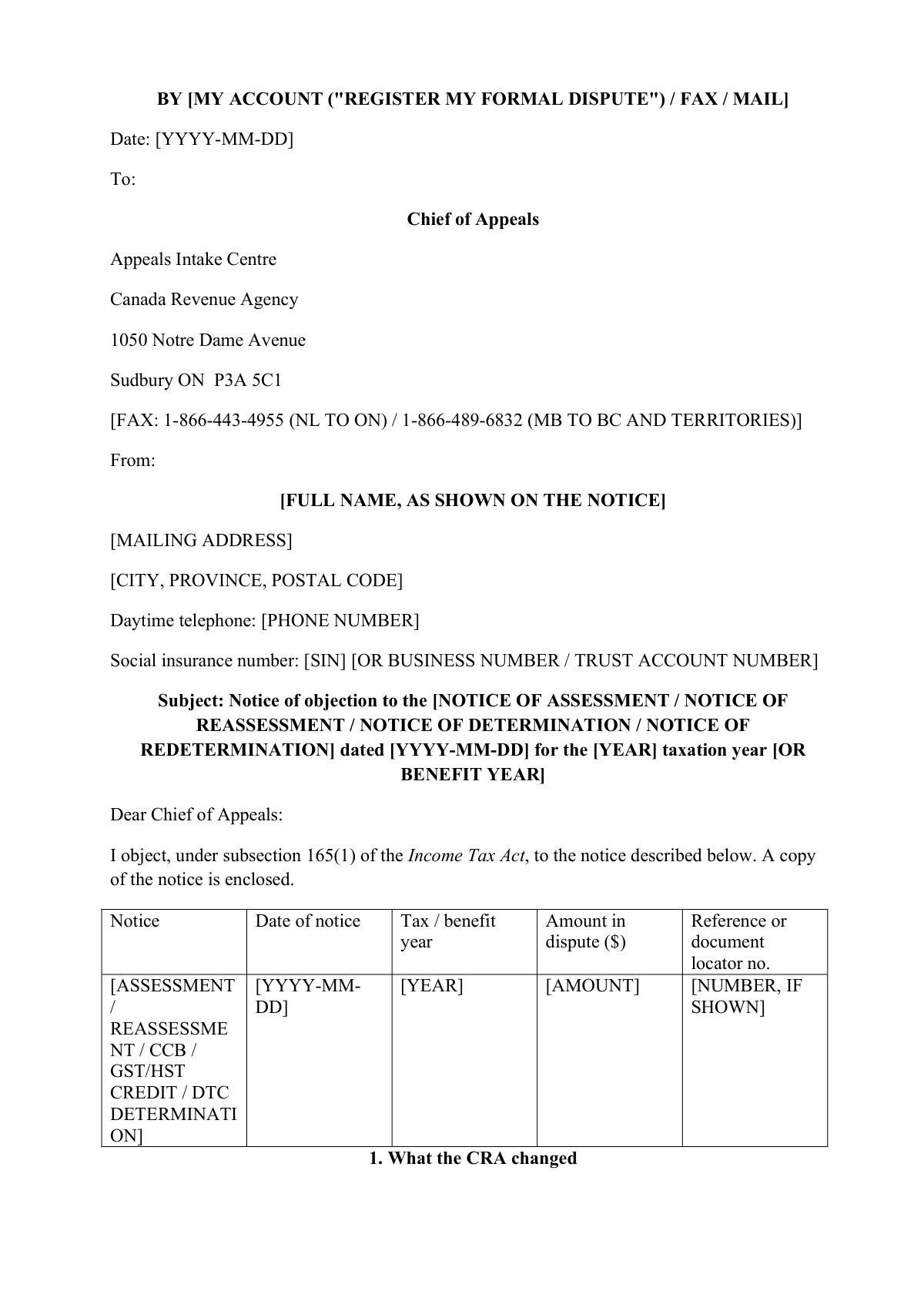
Start typing right in the document — no sign-up. It stays in this browser; save it to your free Layers account to keep it, open it on your phone and share it.

Lida, Layers template assistant
Start with the date on the notice, not the day it reached you. That date drives the 90 days.
Write the facts in short numbered points and attach proof for each one — the appeals officer reviews what is on paper.
An illustrated character, not a lawyer.
Deadlines
The rules, with the source
| What | Deadline | Source |
|---|---|---|
| File the objection — individuals | The later of: 90 days after the day the notice was sent, or 1 year after your filing-due date | Income Tax Act, s.165(1)(a) |
| File the objection — corporations and others | 90 days after the day the notice was sent | ITA, s.165(1)(b) |
| Filing-due date for individuals | April 30 of the next year; June 15 if you or your cohabiting spouse or partner carried on a business | ITA, s.150(1)(d) |
| How to file | In writing, with the reasons and all relevant facts, addressed to the Chief of Appeals | ITA, s.165(1), (2) |
| Late? Apply for an extension | Within 1 year after the objection deadline; show you could not act or intended to object, and applied as soon as you could | ITA, s.166.1(7) |
| Appeal to the Tax Court | After 90 days with no decision on your objection, or within 90 days after the CRA's decision | ITA, s.169(1) |
The same objection rights apply to determinations such as the Canada Child Benefit, the GST/HST credit and the disability tax credit. The CRA has no fixed deadline to decide: the law says 'with all due dispatch' (s.165(3)).
Step by step
What to do, in order
1
Find the notice date
It is printed on your notice of assessment or reassessment. Your deadline counts from it.
2
Call first, if you can
A quick call to the number on the notice sometimes fixes a simple error. Don't let it eat your deadline.
3
Fill in the letter
Say what the CRA changed, the facts, your reasons and exactly what you want changed.
4
Attach your proof
Receipts, slips, contracts, letters — copies only. Include a copy of the notice.
5
File it
Online in My Account ('Register my formal dispute'), on Form T400A, or by signed letter by fax or mail to the Chief of Appeals.
6
Keep the case number
Use it in every follow-up. If 90 days pass with no decision, you may appeal to the Tax Court.
Questions
Is it 90 days or one year?
For individuals, whichever is later: 90 days after the notice was sent, or one year after your filing-due date (usually April 30 of the next year). For a reassessment of an older year, the 90 days is often the later date.
Do I have to use Form T400A?
No. The law asks for a written notice with your reasons and the facts. You can file online, use T400A, or send a signed letter like this one.
I missed the deadline. Is it too late?
You can ask for an extension within one year after the deadline, with an explanation. It is not automatic: you must show you could not act or meant to object, and that you applied as soon as you could.
Official sources
Other documents
Keep the papers in one place
Letters, receipts and notices in one folder you can share with family or a lawyer. The templates and the editor are free; Layers is free for up to 20 people.
This is a ready document and a deadline calculation, not legal advice.