 Jira & Confluence




 Bitrix24
Small business · capital · permits
How to start a small business with small capital — what it costs, how many customers you need, and the permits
Short answer. Sari-sari store, food stall, online selling or a laundry shop: pick one and the fields fill in with examples — put in your own. Business name: If the business is not under your own name: DTI registration, ₱200 barangay / ₱500 city or municipality / ₱1,000 regional / ₱2,000 national scope, plus ₱30 documentary stamp tax; valid 5 years (DTI BNRS — FAQ).
- Register the business name with DTI (if not your own name) — plan it a month before: type the date
- BIR registration (Form 1901) — on or before the day you start: type the date
Check your own case.
The DTI date is a planning suggestion. BIR: on or before the start of business — the first sale, or 30 days after the Mayor’s permit or DTI certificate, whichever comes first (BIR RMC No. 91-2024).
Start typing right in the document — no sign-up. It stays in this browser; save it to your free Layers account to keep it, open it on your phone and share it.
Small business plan
What it costs, how many customers you need — and when it pays back
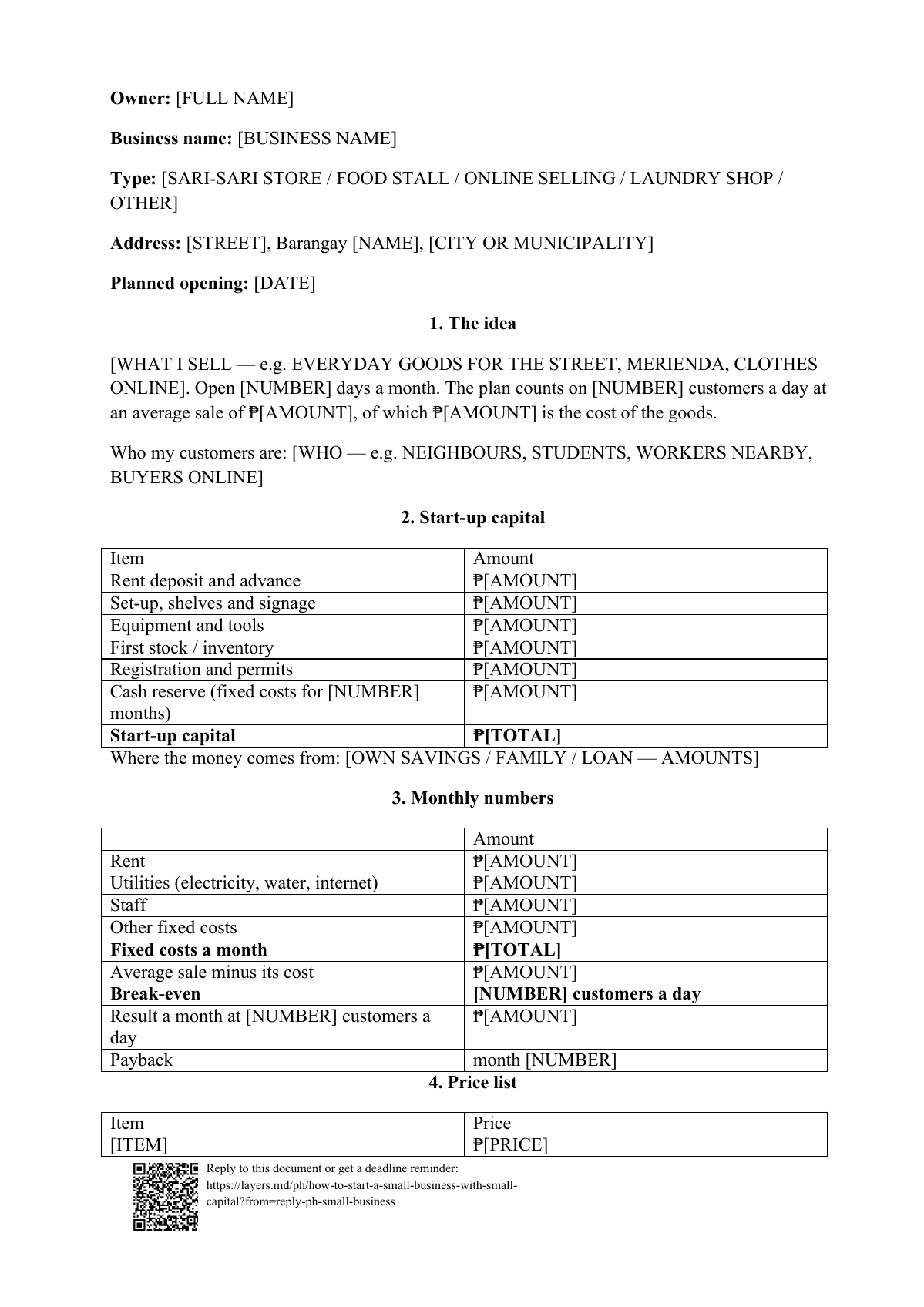
Pick a business and the fields fill in with example costs and prices — put in your own. You get the start-up capital, the break-even in customers a day and the payback month, with a business plan and the registration checklist.
Want the plan saved and a reminder before each registration step? We send it before the date.
The calendar file works without an account. Saving and reminders need a free account to know where to send them.- If the break-even is close to the customers you can really expect, start smaller or lower the costs.
- Fill in the business plan below with your numbers and sign it.
- Register before you open: DTI name, barangay clearance and Mayor’s permit, a sanitary permit if you sell food or drinks, then BIR.
All costs and prices are examples, not averages — put in your own. Arithmetic only, before tax and before your own pay: break-even = fixed costs ÷ ((average sale − cost of the goods) × days open). Registration: DTI business name (bnrs.dti.gov.ph); Mayor’s permit from your city or municipality; for food or drinks a sanitary permit before you operate and health certificates (P.D. 856, Secs. 14–15); BIR Form 1901 on or before the start of business (BIR RMC No. 91-2024).

Atty. Liza, Layers template assistant
Start with what you can sell tomorrow and keep the first stock small — the plan is only as good as your numbers.
Do the permits before you open: the business permit, BIR registration and, for food, the sanitary permit cannot wait for the first customer.
Open the business plan below — I'll help you fill it in.
An illustrated character, not a lawyer.
Deadlines
The rules, with the source
| What | Deadline | Source |
|---|---|---|
| Business name | If the business is not under your own name: DTI registration, ₱200 barangay / ₱500 city or municipality / ₱1,000 regional / ₱2,000 national scope, plus ₱30 documentary stamp tax; valid 5 years | DTI BNRS — FAQ |
| Mayor’s / business permit | Every business needs one from its city or municipality; documents and fees are set by the LGU. A business name is not a license to operate | DTI — Business Registration and Permits |
| Barangay clearance | Asked for with the business permit (for example, Makati City lists it with the lease or title, DTI certificate, locational clearance and inspection) | Makati City — Securing Business Permit |
| If you sell food or drinks | A sanitary permit from the local health office before you operate; a health certificate for everyone working in it; fees set locally | P.D. 856, Secs. 14–15 |
| BIR registration | Form 1901, on or before the start of business; ₱30 documentary stamp tax; the ₱500 annual registration fee is no longer collected since 22 January 2024 | BIR RMC No. 91-2024; BIR Form 1901 (October 2025) |
| If you hire | SSS: report employees within 30 days from hiring. PhilHealth: report new employees (ER2) within 30 days | SSS — Employer; PhilHealth — Reporting your employees |
The calculator does not promise income: it shows what your own numbers mean. Ask your city’s Business Permit and Licensing Office for the local list and fees before you spend.
Step by step
What to do, in order
1
Pick a business
The fields fill in with example costs and prices; replace them with your own quotes.
2
Check the break-even
If the break-even is close to the customers you can really expect, start smaller or lower the costs.
3
Write the plan
The business plan below takes your numbers; sign it — it helps when you talk to family, a partner or a lender.
4
Register before you open
DTI name, barangay clearance and Mayor’s permit, a sanitary permit if you sell food, then BIR.
5
Keep a reserve
Customers come step by step; the plan keeps some months of fixed costs aside.
Questions
What business can I start with small capital?
Ones you can start at home with little equipment — a sari-sari store, online selling, a small food stall. Put in your own costs: the calculator shows the capital you need and when it pays back.
Do I need permits for a sari-sari store at home?
Yes: a Mayor’s / business permit from your city or municipality (with a barangay clearance), BIR registration, and — since it sells food and drinks — a sanitary permit and health certificates.
Is my own pay counted?
No. The result is what the business earns before tax and before you pay yourself.
Official sources
- DTI Business Name Registration System — FAQ (fees, scope, validity)
- DTI — Business Registration and Permits
- Makati City — Securing Business Permit (example of an LGU checklist)
- P.D. No. 856, Code on Sanitation, Chapter III «Food Establishment», Secs. 14–15 (Supreme Court E-Library)
- BIR — RMC No. 91-2024 (registration under the EOPT Act)
- BIR Form 1901 (October 2025)
- SSS — Employer
- PhilHealth — Reporting your employees
Step 1 of 2
Start your own business
- 1 Small business with small capital
- 2 A salon business
Other documents
- 13th month pay not paid
- Want your promotion this year?
- Barangay complaint
- Certificate of Employment request letter
- Cost of rice production per hectare
- Final pay not released?
- 30 day glow up challenge
- How to start a salon business
- How to work abroad without an agency
- Invitation letter for a Japan visa
- Invitation letter for a Korea visa
- Ipon challenge 2026
- Online lending harassment
- Put your ipon to work
- Paluwagan template
- Quit smoking calculator
- Reply to a Notice to Explain
- Salary increase request letter
- Skincare routine chart
- Travel budget template
- ₱60 wage increase not in your payslip?
- Weight loss tracker printable
Keep the papers in one place
Letters, receipts and notices in one folder you can share with family or a lawyer. The templates and the editor are free; Layers is free for up to 20 people.
This is a plan, a calculation and a checklist, not legal, tax or financial advice.