 Jira & Confluence




 Bitrix24
Fertilizer · Soil Health Card · KCC
Fertilizer calculator per acre — by your soil test, with the bags, the cost and your KCC limit
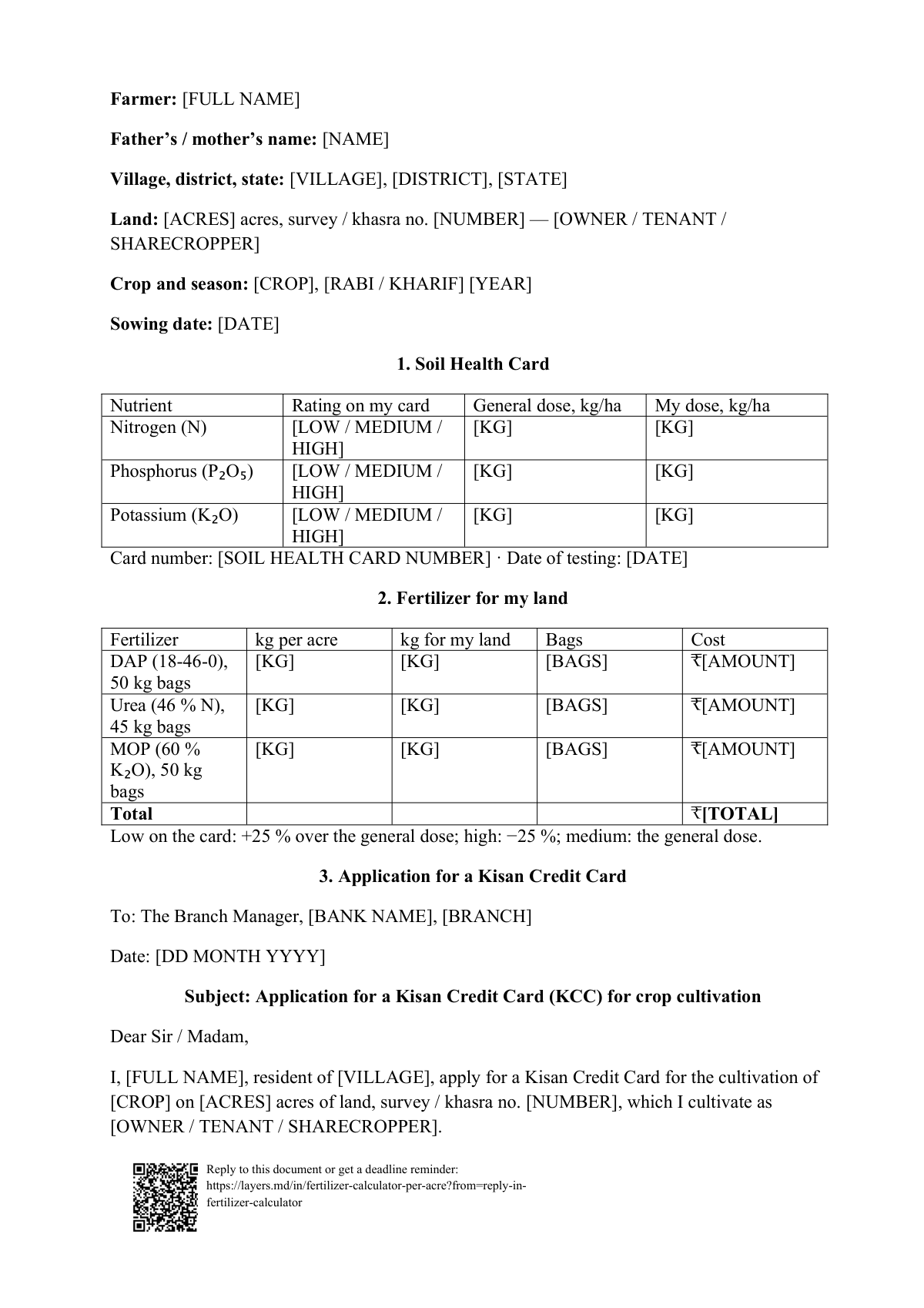
Short answer. Pick the crop and enter the low / medium / high ratings from your Soil Health Card: the calculator gives the urea, DAP and MOP for your acres, the bags and the cost, and the Kisan Credit Card limit for your land. Dose by soil test: Low on the card: +25 % over the general recommended dose; high: −25 %; medium: the general dose (ICAR, Indian Farming 75(06), June 2025).
- Visit the bank for the KCC — plan it three weeks before sowing: type the date
- Buy the fertilizer for the basal dose: type the date
Check your own case.
Planning suggestions, not legal deadlines. The bank fixes the KCC limit from your district’s scale of finance and the area you cultivate.
Start typing right in the document — no sign-up. It stays in this browser; save it to your free Layers account to keep it, open it on your phone and share it.
Fertilizer by soil test · KCC
How much urea, DAP and MOP for your acres — and your KCC limit
Pick the crop, enter your acres and the low / medium / high ratings printed on your Soil Health Card. You get the dose, the bags and the cost, then the Kisan Credit Card limit for your land. The Excel file is a real workbook with formulas — it opens and calculates right in the browser.
Want a reminder to visit the bank for the KCC and to buy fertilizer before sowing? We send it before the date.
The calendar file works without an account. Reminders need a free account to know where to send them.Already keep your own farm workbook in Excel? Open it here — it calculates in the browser too →
- Take the plan to your dealer: the bags are rounded up.
- Fill in the KCC application below with your land details and sign it; the bank may give you its own form as well.
- Ask your Krishi Vigyan Kendra or agriculture officer how to split the urea between sowing and top dressing for your crop.
Soil-test dose: low +25 % over the general recommended dose, high −25 % (ICAR, Indian Farming, June 2025). Wheat: ICAR — HD 3226, NW Plains, irrigated timely sown, N 150 / P 80 / K 60 kg/ha. Rice: PAU, Punjab — N 105, P₂O₅ and K₂O 30 kg/ha only when the soil test shows deficiency. Urea 46 % N, DAP 18-46-0, MOP 60 % K₂O (Fertiliser (Control) Order, 1985). KCC: RBI Master Circular on KCC (2018), para 5.1.1, and RBI KCC Directions 2026 (from 1 January 2027, limit rounded to ₹1,000). Prices: PIB, 2026. Not agronomic advice for your field — follow your Soil Health Card.

Meera, Layers template assistant
Follow your Soil Health Card first. The calculator only turns your card’s ratings into bags and rupees.
Go to the bank before sowing, with the land record and the card — the KCC takes time.
An illustrated character, not a lawyer.
Deadlines
The rules, with the source
| What | Deadline | Source |
|---|---|---|
| Dose by soil test | Low on the card: +25 % over the general recommended dose; high: −25 %; medium: the general dose | ICAR, Indian Farming 75(06), June 2025 |
| Wheat, NW Plains, irrigated, timely sown | N 150, P 80, K 60 kg/ha — urea 255, DAP 175, MOP 100 kg/ha; sowing 5–25 November | ICAR — wheat variety HD 3226 |
| Rice, Punjab, medium soils | N 105 kg/ha (urea 225); P₂O₅ and K₂O 30 kg/ha only when the soil test shows deficiency; with DAP, reduce urea by 25 kg | PAU, in ICAR Indian Farming, June 2025 |
| Fertilizer content | Urea 46 % N; DAP 18 % N and 46 % P₂O₅; MOP 60 % K₂O | Fertiliser (Control) Order, 1985 |
| Prices | Urea ₹242 per 45 kg bag (without neem coating charges and taxes); DAP ₹1,350 per 50 kg bag in Kharif 2026 | PIB, 20 March 2026 and 28 July 2026 |
| KCC limit, first year | Scale of finance (fixed by the district committee) × area + 10 % post-harvest and household + 20 % repairs and maintenance + insurance | RBI Master Circular on KCC (2018), para 5.1.1; RBI KCC Directions 2026 |
| From 1 January 2027 | New RBI KCC Directions: the same formula, the limit rounded to the nearest ₹1,000, a composite facility for six years | RBI KCC Directions 2026, 19 June 2026 |
| Marginal farmers | Up to 1 hectare: a flexible limit of ₹10,000–50,000 (Flexi KCC) | RBI Master Circular on KCC (2018), para 5.2 |
| Documents | One-time land record, tenancy certificate or equivalent; at review, a declaration of the crops you plan | RBI KCC Directions 2026 |
Your Soil Health Card and your state’s package of practices come first: if the card gives a dose for your crop, put that dose into the calculator.
Step by step
What to do, in order
1
Pick the crop
Wheat and rice fill in the official general dose; for any other crop, type the dose from your card or your state.
2
Copy the ratings from your card
Low, medium or high for N, P and K — the calculator adds or cuts 25 %.
3
Check the bags and the cost
Urea comes in 45 kg bags, DAP and MOP in 50 kg bags; the bags are rounded up.
4
See your KCC limit
Ask the bank for your district’s scale of finance per acre and put it in.
5
Sign the KCC application
Bring it with your land record and Soil Health Card; the bank may give you its own form too.
Questions
How much urea per acre for wheat?
With medium soil and the ICAR dose for the NW Plains, about 104 kg of urea per acre when you also apply DAP — the calculator works it out for your acres and your card.
How is the KCC limit calculated?
Scale of finance for the crop × the area you cultivate, plus 10 % for post-harvest and household needs, plus 20 % for repairs and maintenance, plus insurance. The scale of finance is fixed for each district.
Can I use this for other crops?
Yes — choose «Other crop» and enter the recommended dose from your Soil Health Card or your state agriculture department.
Official sources
- ICAR — Indian Farming 75(06), June 2025: Efficient nutrient management technologies for increased rice productivity
- ICAR — Wheat variety HD 3226 (fertilizer dose, NW Plains)
- Fertiliser (Control) Order, 1985 — India Code
- PIB — No increase in urea prices; reduction in bag size (20 March 2026)
- PIB — Affordable fertilizers; DAP at ₹1,350 per bag in Kharif 2026 (28 July 2026)
- RBI — Master Circular, Kisan Credit Card Scheme (4 July 2018)
- RBI — Kisan Credit Card (KCC) Scheme Directions, 2026 (19 June 2026)
- PIB — Impact of the Soil Health Card scheme (ratings low / medium / high)
Other documents
- Bank account frozen by cyber cell?
- Cheque bounce legal notice
- Client not paying your invoice
- Full and final settlement demand letter
- Insurance Ombudsman complaint format
- MSME delayed payment notice
- Notice period buyout calculator
- Full and final not paid
- Statement of purpose for study abroad
- Complaint letter to bank for unauthorised transaction
Keep the papers in one place
Letters, receipts and notices in one folder you can share with family or a lawyer. The templates and the editor are free; Layers is free for up to 20 people.
This is a calculation, a plan and an application letter, not agronomic or financial advice. Follow your Soil Health Card and your agriculture officer.