 Jira & Confluence




 Bitrix24
Negotiable Instruments Act · Section 138
Cheque bounce legal notice — format ready, deadline counted
Short answer. The notice is already open below: fill in the cheque and memo details and send it by registered post. Present the cheque to the bank: Within 6 months of its date or within its validity, whichever is earlier (Negotiable Instruments Act, 1881, s.138, proviso (a)).
- Last day to send the demand notice (30 days from receiving the bank's information): type the date
- Drawer's 15 days to pay — counted from the day the drawer RECEIVES your notice. Enter the delivery date from the postal tracking to see the real date: type the date
- Complaint to the Magistrate — within one month after the 15 days run out. Enter the day after the 15 days end to see the last date: type the date
Check your own case.
Only the first date is counted from the return memo. The 15 days run from the date the drawer receives your notice (Section 138, proviso (c)), and the complaint must be filed within one month of the date the cause of action arises — the day after those 15 days end without payment (Section 142(1)(b)). Run the calculator again with the delivery date, then with the day after the 15 days, to see those dates.
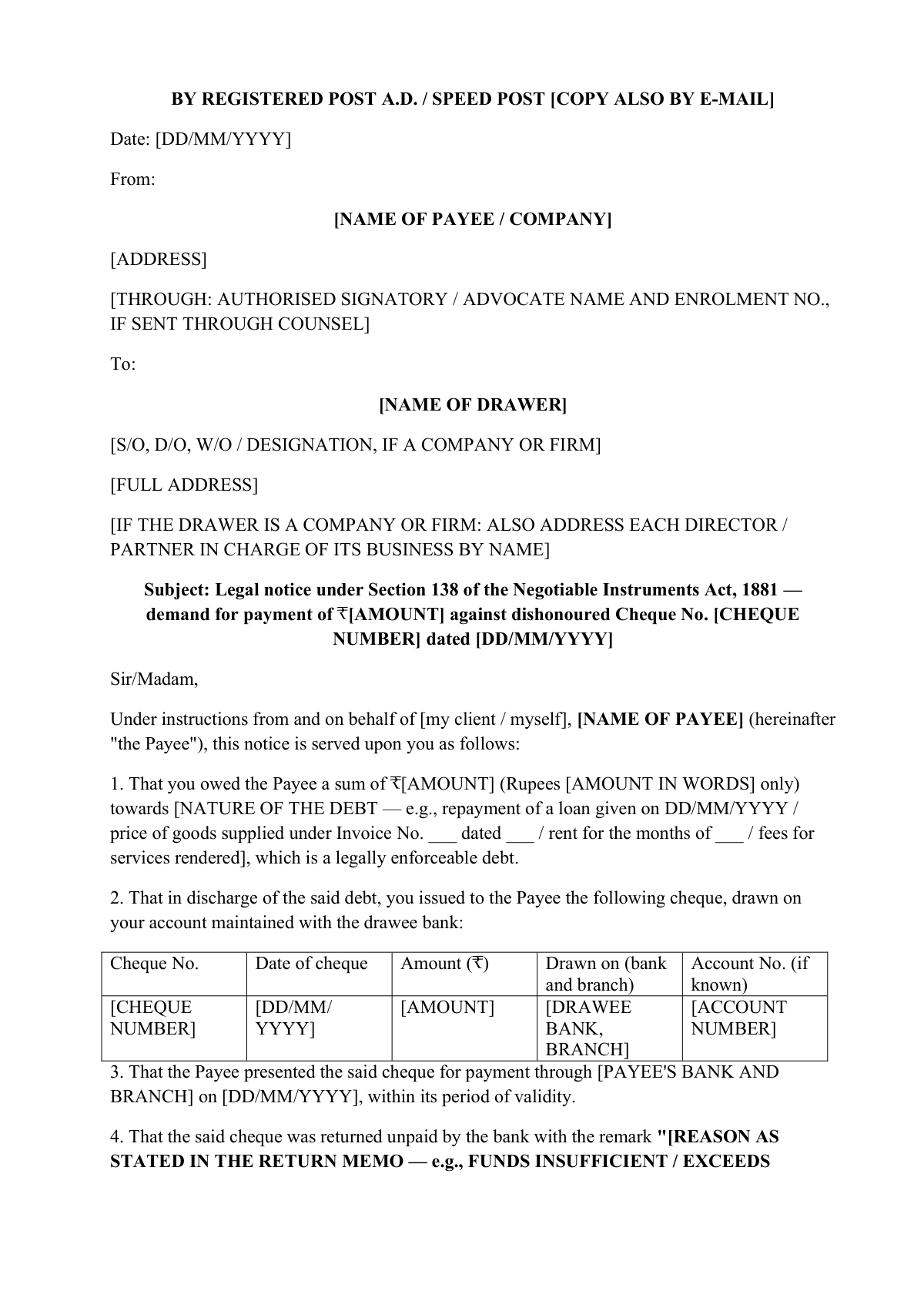
Start typing right in the document — no sign-up. It stays in this browser; save it to your free Layers account to keep it, open it on your phone and share it.

Meera, Layers template assistant
The 30 days start from the day you got the memo, not the date on the cheque. Note that date first, then fill in the notice.
Send the notice to every address you have for the drawer and keep every postal receipt — the dates are what the court will check.
An illustrated character, not a lawyer.
Deadlines
The rules, with the source
| What | Deadline | Source |
|---|---|---|
| Present the cheque to the bank | Within 6 months of its date or within its validity, whichever is earlier | Negotiable Instruments Act, 1881, s.138, proviso (a) |
| Send the written demand notice to the drawer | Within 30 days of receiving the bank's information that the cheque was returned unpaid | s.138, proviso (b) |
| Drawer pays the cheque amount | Within 15 days of receiving the notice | s.138, proviso (c) |
| File the complaint before the Magistrate | Within 1 month of the date the cause of action arises (after the 15 days end); delay can be condoned for sufficient cause | s.142(1)(b) and proviso |
| Which court | Where your bank branch (that collected the cheque) is located; if presented over the counter — the drawer's branch | s.142(2) |
| Penalty | Imprisonment up to 2 years, or fine up to twice the cheque amount, or both; interim compensation up to 20% | s.138, s.143A |
The offence is compoundable (s.147): you can settle with the drawer at any stage. Keep the return memo, the postal receipt and the delivery report — they prove each date.
Step by step
What to do, in order
1
Collect the papers
Original cheque, the bank's return memo and proof of the debt (invoice, loan agreement, ledger).
2
Note the memo date
Write down the date you received the return memo. Your 30 days start here.
3
Fill in and sign the notice
Add the debt, cheque and memo details. Demand the cheque amount within 15 days.
4
Send it with proof
Registered post A.D. or speed post to every address of the drawer; keep receipts and tracking.
5
Wait 15 days from delivery
If the drawer pays, issue a receipt and close the matter.
6
File the complaint
If not paid, file a complaint under s.138 read with s.142 within one month, usually through a lawyer, with an affidavit and the originals.
Questions
I missed the 30 days. Is it over?
The 30-day limit for the notice is written into Section 138 itself, so a late notice puts the criminal complaint at risk. A civil claim for the debt may still be open. Show your dates to a lawyer before you do anything else.
Does the notice have to come from a lawyer?
No. The law asks for a written demand from the payee or holder of the cheque. Many people send it through a lawyer, but you can sign it yourself.
Can we still settle after the complaint is filed?
Yes. Offences under the Act are compoundable (Section 147), so the drawer can pay and settle at any stage.
Official sources
Other documents
Keep the papers in one place
Letters, receipts and notices in one folder you can share with family or a lawyer. The templates and the editor are free; Layers is free for up to 20 people.
This is a ready document and a deadline calculation, not legal advice.