 Jira & Confluence




 Bitrix24
EWS · income and asset certificate
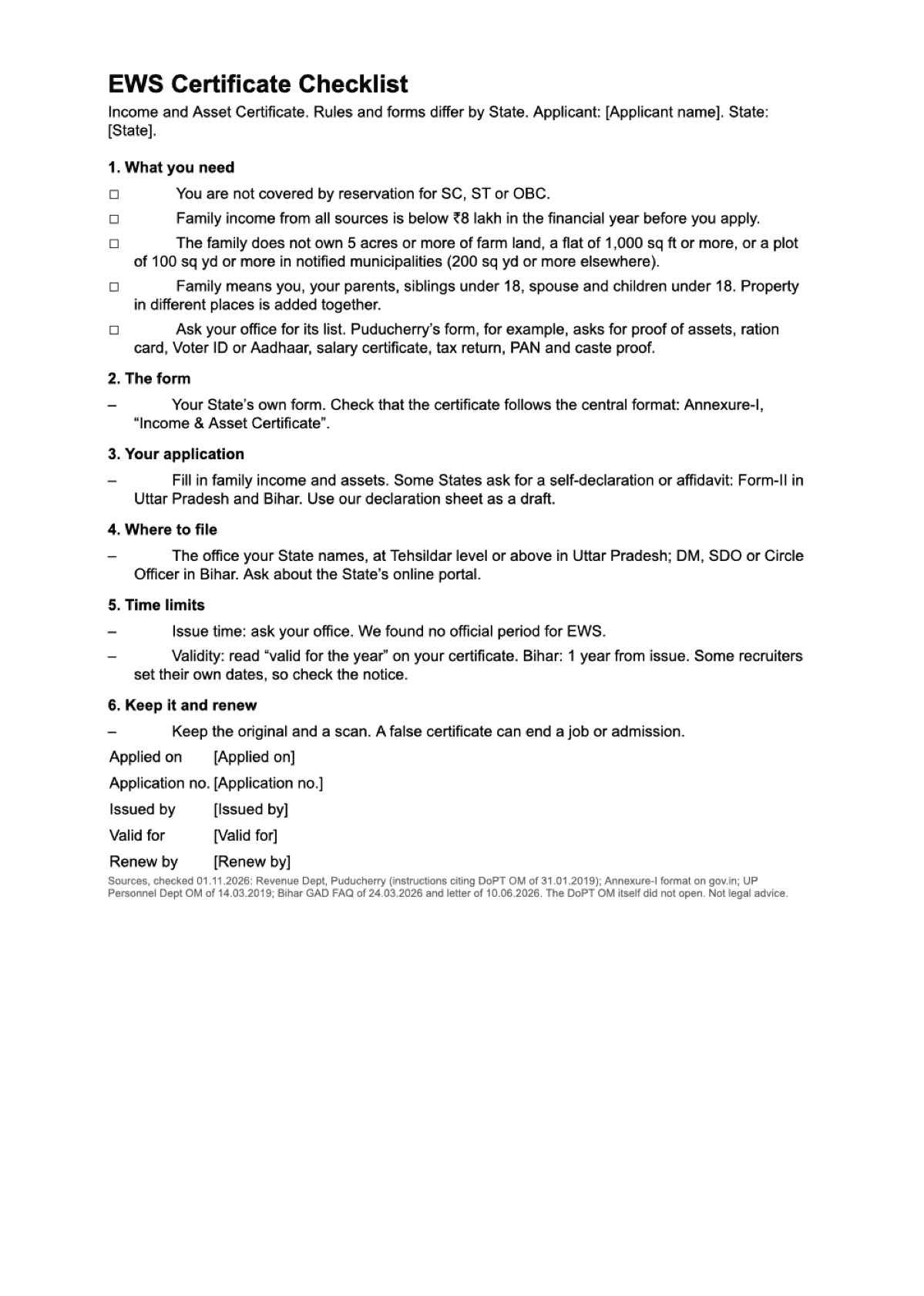
EWS certificate — who qualifies, what counts, and how to apply in your state
Nothing missing before you go.
Tick what you have and see at once what is missing.
Short answer. You can be identified as EWS if you are not covered by SC, ST or OBC reservation and your family's gross annual income is below ₹8 lakh, counting all sources, for the financial year before you apply. Owning certain assets excludes you whatever the income. Each state issues its own certificate.
Updated: · Next check 2027-02-02
Enter a date — we’ll count the deadlines
- Ask your office about renewal bytype the date
Layers never asks for a code or payment in a message.
Check your own case.
This is our planning suggestion, not a rule. Income is counted for the financial year before you apply, so ask your office and the place you submit it how long they accept the certificate.
We will ask you to confirm this address, then email you the recipient’s reply.
Start typing right in the document — no sign-up. It stays in this browser; save it to your free Layers account to keep it, open it on your phone and share it.
Meera, Layers template assistant
Check the asset list before you apply.
Keep your application number.
Deadlines
The rules, with the source
| What | Deadline | Source |
|---|---|---|
| Who | People not covered by reservation for SC, ST or Socially and Educationally Backward Classes | Ministry of Social Justice, Annual Report 2019-20 |
| Income | Family gross annual income below ₹8.00 lakh | Ministry of Social Justice, Annual Report 2019-20 |
| What income counts | All sources: salary, agriculture, business, profession. For the financial year before the year of application | Ministry of Social Justice, Annual Report 2019-20 |
| Family | You, your parents, siblings below 18, your spouse and children below 18 | Ministry of Social Justice, Annual Report 2019-20 |
| Assets that exclude you | 5 acres of agricultural land and above; residential flat of 1000 sq ft and above; residential plot of 100 sq yards and above in notified municipalities, 200 sq yards and above elsewhere | Ministry of Social Justice, Annual Report 2019-20 |
| Documents, example of Jharkhand | Identity proof, proof of residence, self declaration | Jharkhand, serviceonline.gov.in |
| How to apply, example of Jharkhand | Online or at a kiosk, after registering. The portal gives no delivery time | Jharkhand, serviceonline.gov.in |
Checked on 1 November 2026. The national rules are as described in the 2019-20 report: we could not open the DoPT memorandum or the national services portal. Jharkhand is one example. Ask your state's revenue office for its form, office and fee.
What does not exist
Be careful with anyone who offers this.
- “One national EWS form”: Each state runs its own service.
- “Income is all that matters”: Owning a listed asset excludes you whatever the income.
- “Only your own salary counts”: Family income from all sources counts.
Step by step
What to do, in order
1
What you need
Check income and assets against the rules, then collect ID, residence proof and self declaration.
2
Find your state's form
On your state's services portal or at your revenue office.
3
Fill in the application
Use the checklist so family and income details match your papers.
4
Submit it
Online, at a kiosk or at the office your state names.
5
Ask about the time
Your state sets it. Note the application number.
6
Keep the certificate
Save a copy, and ask where you submit it how long it is accepted.
Questions
What is the income limit for EWS?
Family gross annual income below ₹8 lakh, from all sources.
Whose income counts?
You, your parents, siblings below 18, your spouse and children below 18.
Who issues the certificate?
Your state decides. Ask your revenue office or check its portal.
Which year's income is used?
The financial year before the year of application.
Official sources
Other documents
Keep the papers in one place
Letters, receipts and notices in one folder you can share with family or a lawyer. The templates and the editor are free; Layers is free for up to 20 people.
This is a checklist, not legal advice. Your state's authority decides.