 Jira & Confluence




 Bitrix24
Code on Wages, 2019 · Section 17(2)
Full and final settlement demand letter — your dues are late after 2 working days
Short answer. The demand letter is already open below: fill in your dates and the amounts owed and send it to HR. Wages after resignation, removal, dismissal, retrenchment or closure: Within 2 working days (Code on Wages, 2019, s.17(2)).
- Wages due: within 2 working days: type the date
- Gratuity due (if eligible): within 30 days: type the date
- Last date to file a claim under s.45 (3 years): type the date
Working days: Monday to Friday; public holidays are not deducted. Check your own case.
Section 17(2) of the Code on Wages, 2019: wages within two working days of resignation, removal, dismissal, retrenchment or closure. Section 56(3) of the Code on Social Security, 2020: gratuity within thirty days of becoming payable. Section 45(6) of the Code on Wages: a claim within three years from the date it arises — we count from your last day, which is the safe side. Working days are counted Monday to Friday; holidays and six-day weeks are not taken into account.
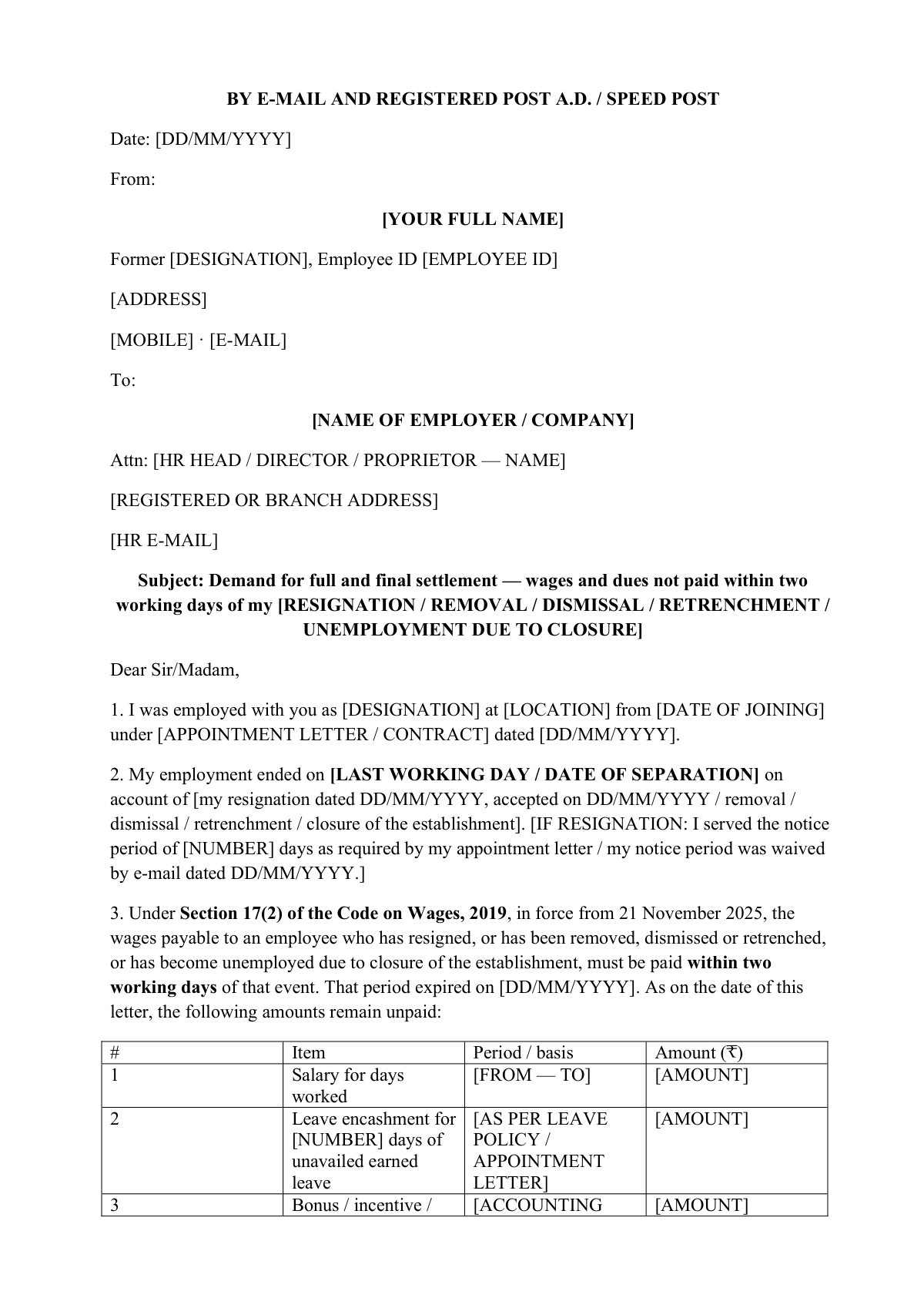
Start typing right in the document — no sign-up. It stays in this browser; save it to your free Layers account to keep it, open it on your phone and share it.

Meera, Layers template assistant
Start with the date your employment ended — every deadline on this page counts from it.
Put each amount on its own line in the table. A clear break-up is easier for HR to pay and for the claim authority to check.
An illustrated character, not a lawyer.
Deadlines
The rules, with the source
| What | Deadline | Source |
|---|---|---|
| Wages after resignation, removal, dismissal, retrenchment or closure | Within 2 working days | Code on Wages, 2019, s.17(2) |
| Different time limit set by the State Government | Possible — check your State's notification | Code on Wages, 2019, s.17(3) |
| Deductions from wages | Only those authorised under the Code | Code on Wages, 2019, s.18(1) |
| Gratuity — eligibility | 5 years of continuous service; not required on death, disablement or end of fixed term employment (pro rata) | Code on Social Security, 2020, s.53 |
| Gratuity — payment | Within 30 days from the date it becomes payable; simple interest if late | Code on Social Security, 2020, s.56(3)–(4) |
| Bonus | Within 8 months from the close of the accounting year | Code on Wages, 2019, s.39(1) |
| Claim before the authority | Within 3 years from the date the claim arises; later on sufficient cause | Code on Wages, 2019, s.45(6) |
| Compensation the authority can order | Up to 10 times the claim determined | Code on Wages, 2019, s.45(2) |
These provisions came into force on 21 November 2025 (Code on Wages — S.O. 5322(E); Code on Social Security — S.O. 5319(E), both dated 21.11.2025). Before that, the Payment of Wages Act did not set a 2-day limit for employees who resigned.
Step by step
What to do, in order
1
Note your last working day
Check the date in your resignation acceptance or termination letter. Your 2 working days start here.
2
List what is owed
Salary for days worked, leave encashment, bonus, reimbursements, notice pay, gratuity. Use your last payslip and leave balance.
3
Fill in the letter
Add the amounts, your bank details and the documents you need: relieving letter, experience certificate, Form 16.
4
Send it with proof
E-mail HR and send a copy by registered post or speed post. Keep the tracking report.
5
Wait 7 days
If the company pays, check the settlement statement line by line before signing any no-dues form.
6
File a claim
If not paid, file a claim under s.45 of the Code on Wages with the claim authority, or ask the Inspector-cum-Facilitator to file it. You have 3 years.
Questions
Does the 2-day rule apply if I resigned?
Yes. Section 17(2) of the Code on Wages names resignation together with removal, dismissal, retrenchment and closure. The old rule under the Payment of Wages Act did not cover resignation.
My company says F&F takes 45 days as per policy. Is that allowed?
A company policy cannot extend a time limit set by the Code. Only the appropriate Government can set a different limit (s.17(3)). Gratuity has its own 30-day rule.
Am I eligible for gratuity after 2 years?
On a regular job — usually only after 5 years of continuous service. On a fixed term contract — the Code does not require 5 years and gratuity is paid pro rata; the government says one year of service is enough.
Official sources
Other documents
Keep the papers in one place
Letters, receipts and notices in one folder you can share with family or a lawyer. The templates and the editor are free; Layers is free for up to 20 people.
This is a ready document and a deadline calculation, not legal advice.