 Jira & Confluence




 Bitrix24
New Zealand · Employment Relations Act 2000 · s.114 · 90 days
Dismissed or treated unfairly at work? — personal grievance letter ready, 90 days counted
Short answer. Your letter to the employer is open below: tick the grounds, add the dates and what you are asking for. Raise the grievance: Within 90 days beginning with the date of the action or the date it came to your notice, whichever is later (Employment Relations Act 2000, s.114(1), (7)(b)).
- Last day to raise the personal grievance (90 days beginning with this date): type the date
- Sexual harassment: 12 months beginning with this date — the last day is the day BEFORE this date: type the date
- If dismissed: last day to ask for a written statement of the reasons (60 days after the dismissal): type the date
- If this is instead the date the employer received your request for reasons: last day for their written statement (14 days): type the date
Check your own case.
A personal grievance must be raised with the employer within 90 days beginning with the date the action occurred or came to your notice, whichever is later; for sexual harassment, 12 months (Employment Relations Act 2000, s.114(1), (7)). 'Beginning with' means that date is day 1, so the 90th day is 89 days after it. Weekends and holidays are counted. A dismissed employee may ask for a written statement of reasons within 60 days, and the employer must give it within 14 days after receiving the request (s.120). If you miss the 90 days, the employer may agree to a late grievance; otherwise the Employment Relations Authority can allow it only in exceptional circumstances (s.114(3), (4)).
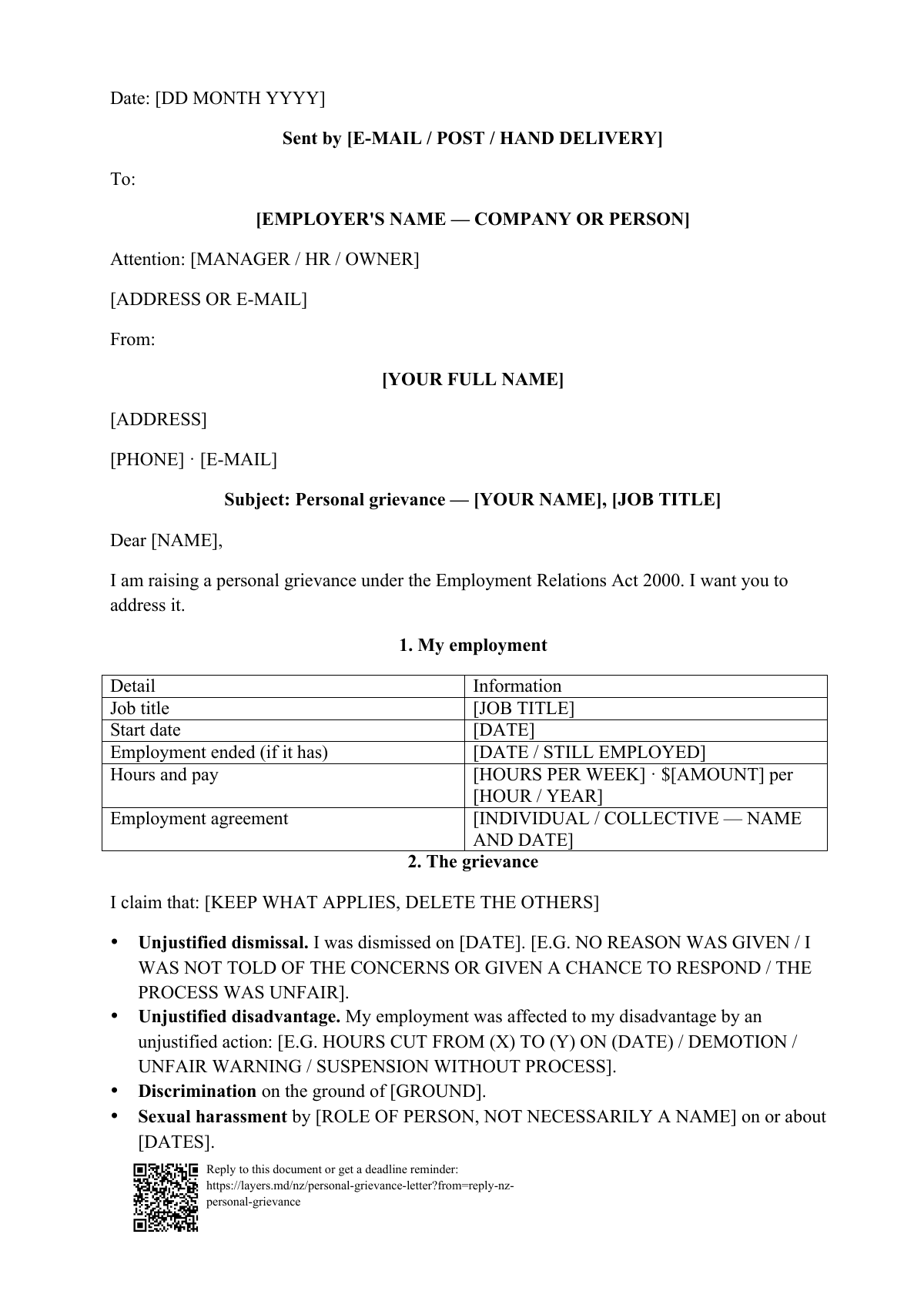
Start typing right in the document — no sign-up. It stays in this browser; save it to your free Layers account to keep it, open it on your phone and share it.

Lida, Layers template assistant
Enter the date you were dismissed or found out what happened, and I will show your last day to raise the grievance.
Write facts with dates, not feelings. The employer, a mediator or the Authority will read the table first.
An illustrated character, not a lawyer.
Deadlines
The rules, with the source
| What | Deadline | Source |
|---|---|---|
| Raise the grievance | Within 90 days beginning with the date of the action or the date it came to your notice, whichever is later | Employment Relations Act 2000, s.114(1), (7)(b) |
| Sexual harassment | Within 12 months beginning with that date | Employment Relations Act 2000, s.114(7)(a), s.103(1)(d) |
| What counts as raising it | Making the employer aware, or taking reasonable steps to do so, that you allege a grievance you want addressed | Employment Relations Act 2000, s.114(2) |
| Late grievance | Only with the employer's consent, or leave from the Authority for exceptional circumstances | Employment Relations Act 2000, s.114(1), (3), (4) |
| Statement of reasons for dismissal | Ask within 60 days; employer must answer within 14 days after receiving the request | Employment Relations Act 2000, s.120 |
| Taking it to the Authority | No action more than 3 years after the grievance was raised | Employment Relations Act 2000, s.114(6) |
| Earning $200,000 a year or more | A dismissal grievance may be excluded; other grounds remain (from 21 February 2026) | Employment Relations Act 2000, s.113A, s.113B |
Grounds for a personal grievance are listed in s.103(1): unjustified dismissal, unjustified disadvantage, discrimination, sexual or racial harassment, adverse treatment because of family violence and others. Trial-period dismissals, contractors and some other cases have their own rules.
Step by step
What to do, in order
1
Count the 90 days now
Use the date of the action, or when you found out, whichever is later.
2
Choose the grounds
Dismissal, disadvantage, discrimination or harassment. You can raise more than one.
3
List what happened
Short dated facts and the evidence for each: messages, rosters, payslips.
4
Say what you want
Reinstatement, lost wages, compensation, a reference — be specific.
5
Send it and keep proof
E-mail or post to the employer or HR, and keep the sent copy.
6
Mediation if no agreement
Employment New Zealand offers free mediation; the Authority is the next step.
Questions
Does the letter have to be formal?
No. The law only requires that the employer is made aware you have a grievance you want addressed. A clear letter with dates is the safest way to prove it.
What if the 90 days have already passed?
Ask the employer to agree to a late grievance. If they refuse, the Employment Relations Authority can allow it only in exceptional circumstances.
I earn over $200,000. Can I still raise a grievance?
Since 21 February 2026 a dismissal grievance may be excluded at that pay level. Grievances for discrimination, harassment and other grounds are still possible.
Official sources
Other documents
Keep the papers in one place
Letters, receipts and notices in one folder you can share with family or a lawyer. The templates and the editor are free; Layers is free for up to 20 people.
This is a ready document and a deadline calculation, not legal advice.