 Jira & Confluence




 Bitrix24
Insurance Ordinance, 2000 · ss.118 and 129
Insurance claim delay complaint letter — 90 days counted, Ombudsman next
Short answer. The letter is already open below: fill in your policy and claim details and send it. Insurer pays the claim: Within 90 days from the date payment becomes due or the date the claimant complies with all requirements (including complete papers), whichever is later (Insurance Ordinance, 2000, s.118(1)).
- Insurer must pay by this day; after it, liquidated damages accrue (90 days): type the date
- Insurer's one month to answer your notice — enter the date the insurer RECEIVED this letter to see the real date: type the date
- Last day to complain to the Federal Insurance Ombudsman (1 + 3 months) — again counted from the date the insurer received this letter: type the date
Check your own case.
Only the first date is counted from your documents: section 118 gives the insurer 90 days from the date payment becomes due or the date you complied with all requirements, whichever is later. The other two are counted from the day the insurer receives your written notice under section 129(2): one month for its reply, then a further three months to complain to the Ombudsman. Run the calculator again with the delivery date of your letter.
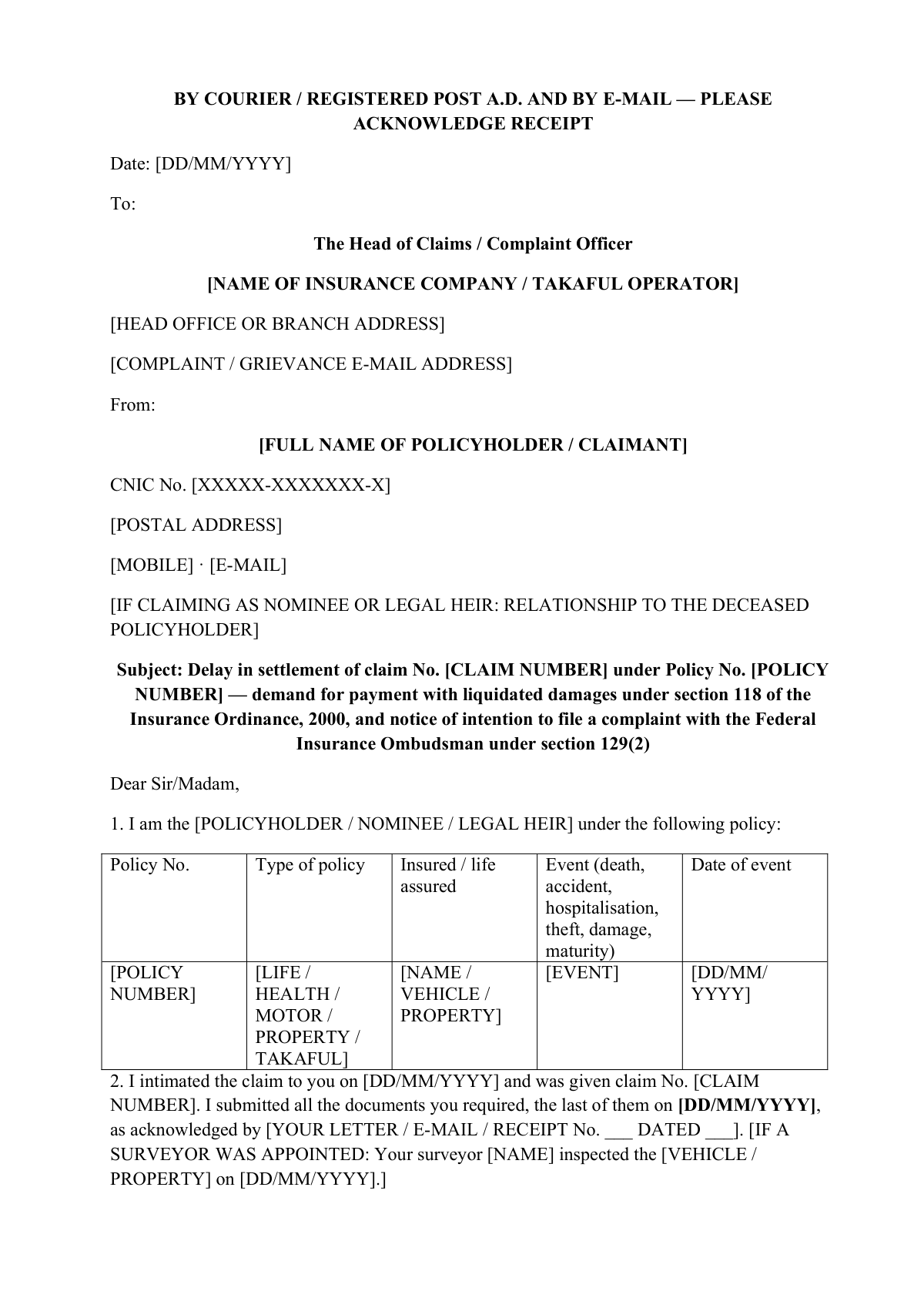
Start typing right in the document — no sign-up. It stays in this browser; save it to your free Layers account to keep it, open it on your phone and share it.

Meera, Layers template assistant
Tell me the date you submitted the last claim document, and I will show you the day the insurer's 90 days run out.
When the insurer receives this letter, note the date: the Ombudsman timeline runs from it.
An illustrated character, not a lawyer.
Deadlines
The rules, with the source
| What | Deadline | Source |
|---|---|---|
| Insurer pays the claim | Within 90 days from the date payment becomes due or the date the claimant complies with all requirements (including complete papers), whichever is later | Insurance Ordinance, 2000, s.118(1) |
| Liquidated damages for late payment | For the whole period of delay, at monthly rests, at base rate + 5%; the insurer escapes only if it proves circumstances beyond its control (a reinsurer's delay does not count) | Insurance Ordinance, 2000, s.118(1)–(2) |
| Base rate | The latest SBP repurchase rate for six-month Treasury Bills (or the fallbacks listed in the law) | Insurance Ordinance, 2000, s.2 |
| Written notice to the insurer before going to the Ombudsman | Tell the insurer in writing you intend to complain; it has one month to reply | Insurance Ordinance, 2000, s.129(2) |
| Complaint to the Federal Insurance Ombudsman | At any time within a further three months after that month; delay can be condoned for reasonable grounds; in writing, on solemn affirmation or oath | Insurance Ordinance, 2000, s.129(1)–(2) |
| Ombudsman's decision | Insurer's comments within 15 days (+7 on sufficient cause); complaint disposed of within 60 days | Federal Ombudsmen Institutional Reforms Act, 2013, s.9(1), (5) |
| If you disagree with the decision | Review petition within 30 days; representation to the President within 30 days | Federal Ombudsmen Institutional Reforms Act, 2013, ss.13, 14 |
The Ombudsman cannot take a matter that is pending before a court or tribunal, and if your complaint is rejected you can still go to court. The Insurance Ordinance also allows an appeal to the SECP within 30 days, but the 2013 Act, which overrides it, provides a representation to the President within 30 days.
Step by step
What to do, in order
1
Find your 'complete papers' date
The day you handed in the last document the insurer asked for. Keep the receipt or e-mail.
2
Count the 90 days
Enter that date: after the 90th day the insurer owes late-payment damages as well.
3
Fill in and send the letter
By courier or registered post A.D., and by e-mail. Keep proof of the delivery date.
4
Wait one month
Count from the day the insurer received your letter. Answer any request for documents in writing.
5
Complain to the Ombudsman
If there is no reply or the reply is unsatisfactory, file with the Federal Insurance Ombudsman within the next three months.
Questions
From which date do the 90 days run?
From the date the payment became due or the date you completed all requirements, including complete papers — whichever is later. That is why proof of your last document matters so much.
How much are the late-payment damages?
Base rate plus five percent a year, calculated at monthly rests on the amount payable, for the whole period of delay. The base rate is the State Bank's six-month Treasury Bill repurchase rate.
Does this guarantee my claim will be paid?
No. If the insurer has a valid reason to refuse, the letter will not change that. It puts your demand on record, starts the clock for the Ombudsman and asks the insurer to explain in writing.
Official sources
Other documents
Keep the papers in one place
Letters, receipts and notices in one folder you can share with family or a lawyer. The templates and the editor are free; Layers is free for up to 20 people.
This is a ready document and a deadline calculation, not legal advice.