 Jira & Confluence




 Bitrix24
A task list disguised as a charter
The charter should explain why the project exists and who can make decisions. Detailed tasks belong in the plan.
Work
ProjectsTasks, sprints and milestones PagesDocs and knowledge base FormsSurveys, quizzes, booking FlowProcesses and mockupsProject kickoff · step 1
Use the charter to make authority, scope, outcomes and the approval decision explicit before detailed planning begins.
No sign-up to start. The document stays editable in this browser; sign-in appears only when you save it to a workspace or invite a team.
Start editing here — no sign-up. Send the result first; sign in only if you want to keep it in a workspace or invite your team.
The situation
A project is about to start, but the team does not yet share one definition of the problem, outcome, boundaries or decision owner. The charter is the compact agreement that authorises the work and gives the plan a stable starting point.
How to use it
1
Describe the problem or opportunity without prescribing the solution.
2
Write a testable objective and success measures that can be accepted or rejected.
3
List what is in scope and out of scope, plus assumptions and constraints.
4
Name the sponsor, project lead and the decision that starts the work.
Filled example
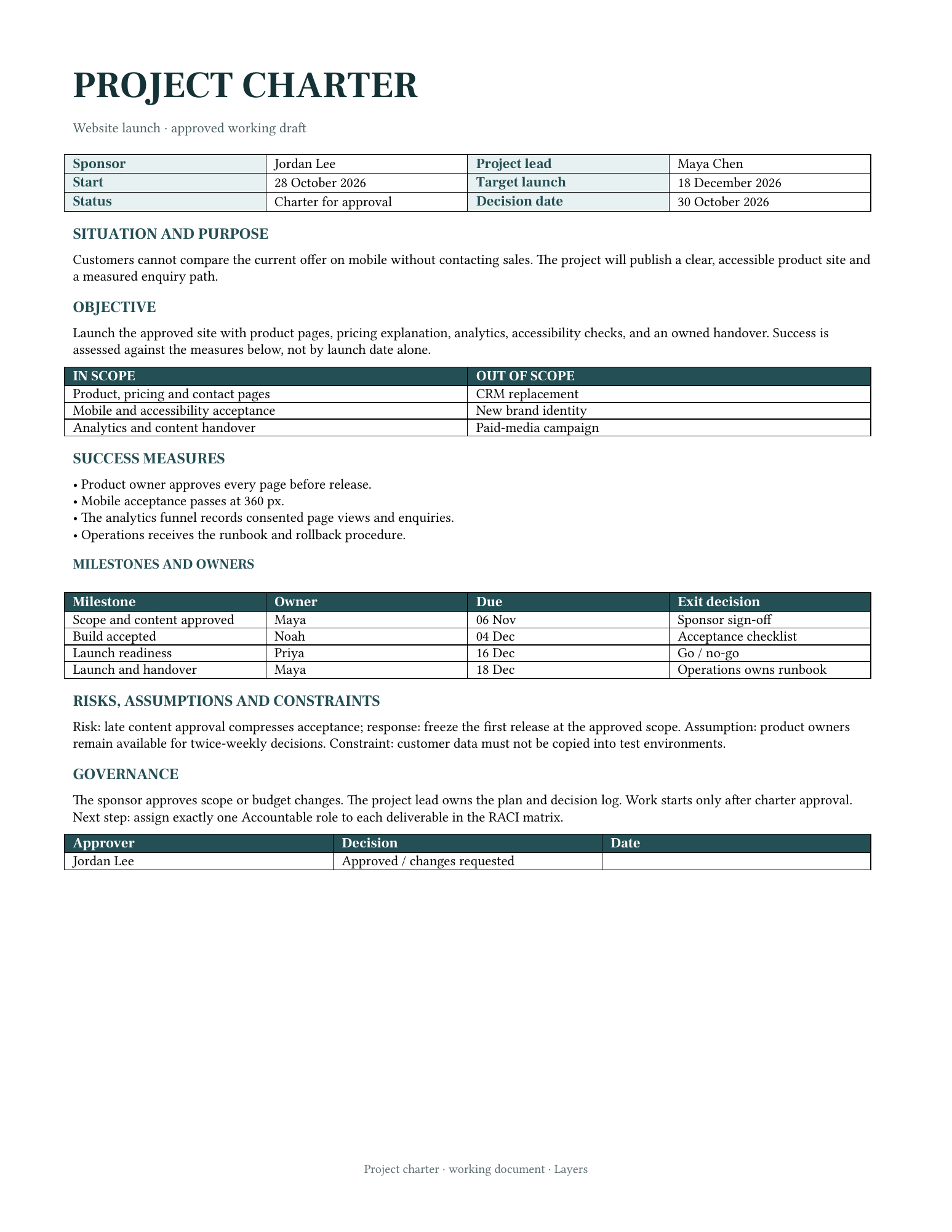
The example charters a website launch. It separates the release from a CRM replacement, names the sponsor and project lead, defines acceptance and makes go/no-go an explicit decision.
Common mistakes
The charter should explain why the project exists and who can make decisions. Detailed tasks belong in the plan.
A release date is a milestone, not proof of an outcome. Add acceptance and operating measures.
If the boundary is silent, every adjacent request can become part of the project.
FAQ
The sponsor or other person who controls the authority and resources needed for the project.
As short as possible while still resolving purpose, scope, success, governance and approval. This example fits on one page.
No. The charter authorises and bounds the work. The project plan then sequences tasks, owners, dates and dependencies.
Yes. A PDF with a “Made with Layers” line is free and needs no registration; the clean Word file is on the paid Send plan.
We use no advertising cookies. With your consent we turn on Google Analytics to see which pages help; without it nothing is sent to Google. About cookies