 Jira & Confluence




 Bitrix24
Before Chapter I
Preliminary pages
- Title page
- Approval sheet
- Acknowledgment · dedication
- Abstract
- Table of contents
- Lists of tables and figures
Work
ProjectsTasks, sprints and milestones PagesDocs and knowledge base FormsSurveys, quizzes, booking FlowProcesses and mockupsFor Senior High School · Philippines
The plan of the whole paper is open below — title page to appendices, with what to write in every part. Start typing, no sign-up; the formatted paper with page numbers is the Word version.
Start typing right in the document — no sign-up. It stays in this browser; save it to your free Layers account to keep it, open it on your phone and share it.
Practical Research format
| Paper | US Letter, 8.5 × 11 in (short bond) |
|---|---|
| Margins | 1.5 in left for binding, 1 in top, right and bottom |
| Font and spacing | Times New Roman 12, double-spaced |
| Chapter titles | Centered, bold, capitals: CHAPTER I, then the title |
| Page numbers | i, ii, iii for the preliminary pages; 1, 2, 3 from Chapter I, top right |
| Tables and figures | APA 7: Table 1 in bold, title in italics, above |
| References | APA 7th edition, alphabetical, hanging indent |
The most common format in Senior High School research manuals. Your school’s manual and your adviser come first.
Chapter 1 to 5
Before Chapter I
Chapter I
Chapter II
Chapter III
Chapter IV
Chapter V
After Chapter V: References (APA 7th edition) and Appendices — letter of permission, informed consent and assent, the instrument, validation sheet, computations, documentation, curriculum vitae.
How to write it
1
A title of 12 to 15 words that names the variables, the respondents and the place.
2
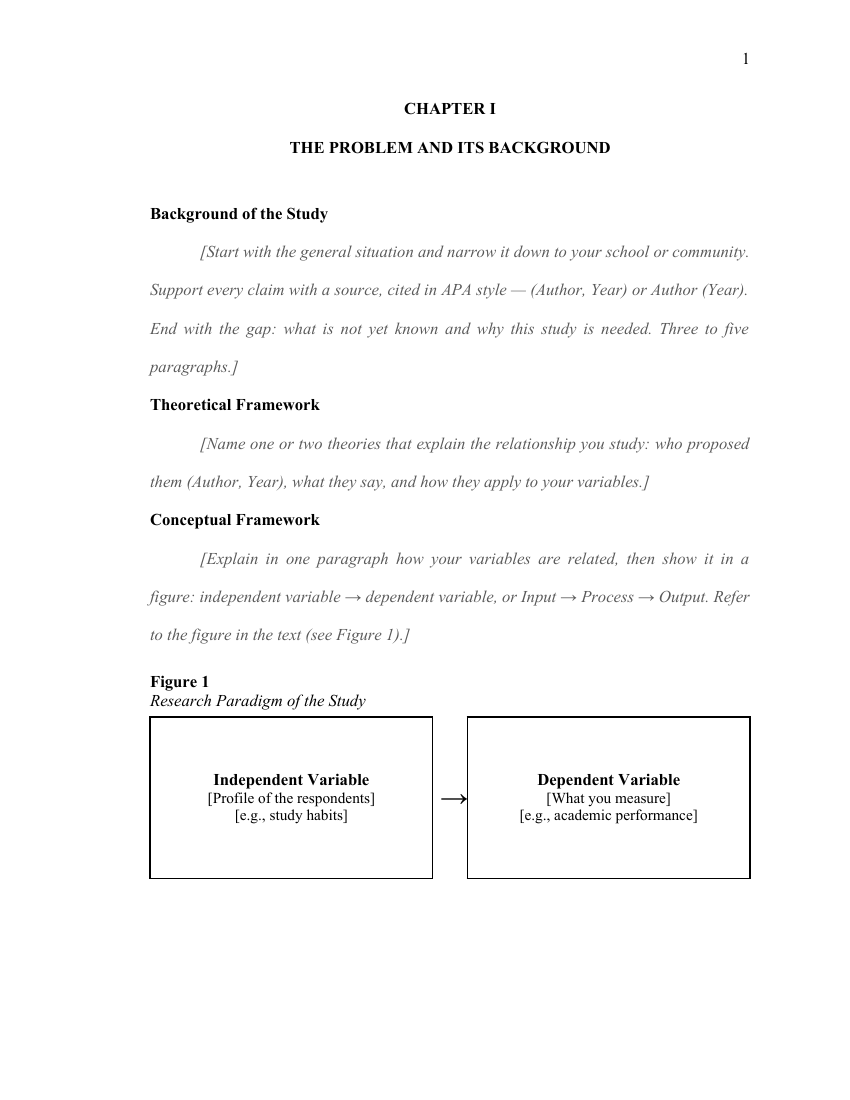
Background, frameworks, the questions of the study, hypothesis, significance, scope and definitions.
3
Chapter II: related literature and studies by variable, each cited in APA 7, then the synthesis.
4
Chapter III: design, respondents and sampling, the validated instrument, statistics and ethics.
5
Chapter IV tables with analysis and interpretation; Chapter V findings, conclusions and recommendations; the abstract last.
Free templates
Open each as a Layers page with a checklist for every part, or as the formatted Word file — no sign-up to look.
Templates written for this page; grey text in [brackets] tells you what to write. Follow the research format of your school and your adviser. Licence CC BY 4.0 · © Layers (layers.md).
Exam week too
Title page, approval sheet, abstract and table of contents, then Chapter I (the problem and its background), II (review of related literature), III (methodology), IV (presentation, analysis and interpretation of data) and V (summary, conclusions, recommendations), APA 7 references and appendices. Your school’s research manual has the final say.
Usually yes — Practical Research 2 is quantitative: keep the hypothesis and statistics. Practical Research 1 is usually qualitative. The template works for both.
No. Look at the plan right here and open the template in Layers without an account. Sign in free only to save your own copy and keep editing.
There is no single national format: each school or division sets its own research manual. This template follows the most common Senior High School format. Your school’s manual and your research adviser come first — margins, chapter titles and the order of the preliminary pages differ.
Both. Practical Research 2 is usually quantitative — keep the hypothesis and statistics. For a qualitative Practical Research 1 paper, delete the hypothesis and describe the data analysis (for example, thematic analysis) instead of the statistical treatment.
Yes, in Word: the chapters and their parts use heading styles. After editing, right-click the table of contents and choose Update field → Update entire table.
Yes. Open it in Layers and share the folder with your groupmates: everyone writes their part in the same document.
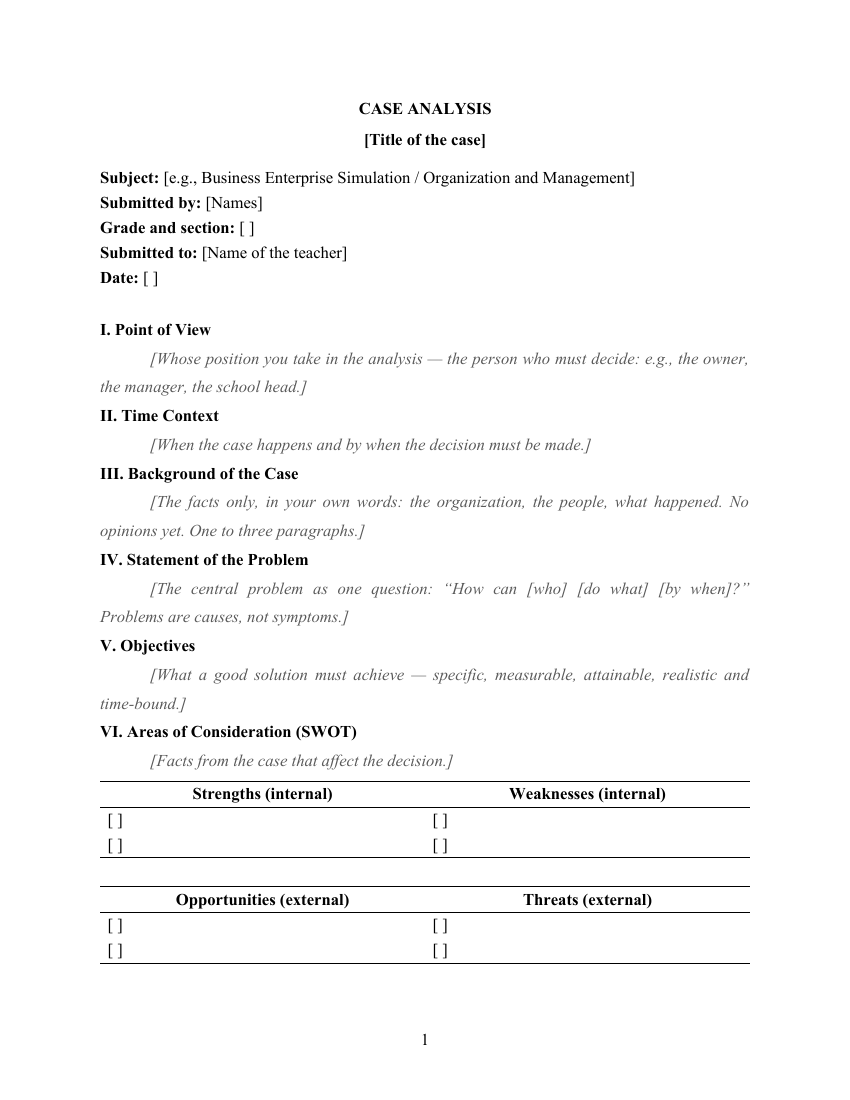
For case analysis in ABM and other subjects: you take the decision-maker’s point of view, list the facts and the SWOT, compare alternative courses of action and recommend one with a plan of action.
One shared document for the paper, a folder for the data, chat and calls for the group and your adviser. Free for groups of up to 20 people.
Layers is an independent product and is not affiliated with DepEd or any school.
We use no tracking cookies: the site only remembers the theme and language you choose. Analytics and third-party videos will only be turned on with your consent. About cookies