 Jira & Confluence




 Bitrix24
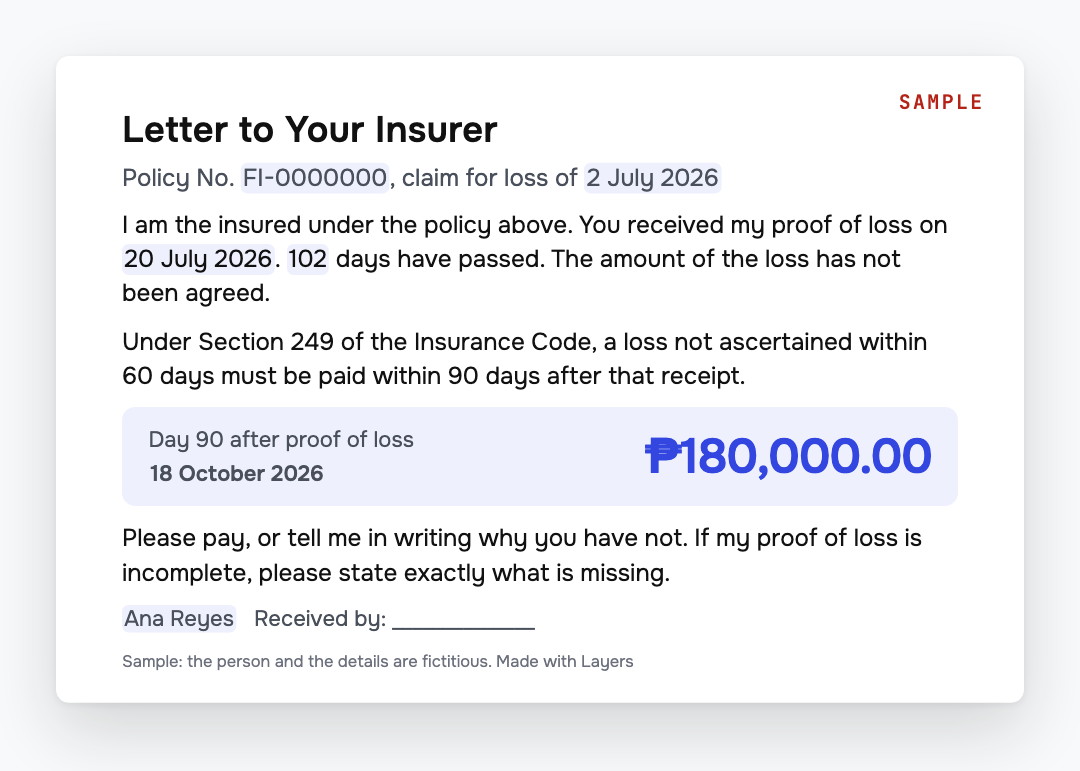
Ready, not blank.
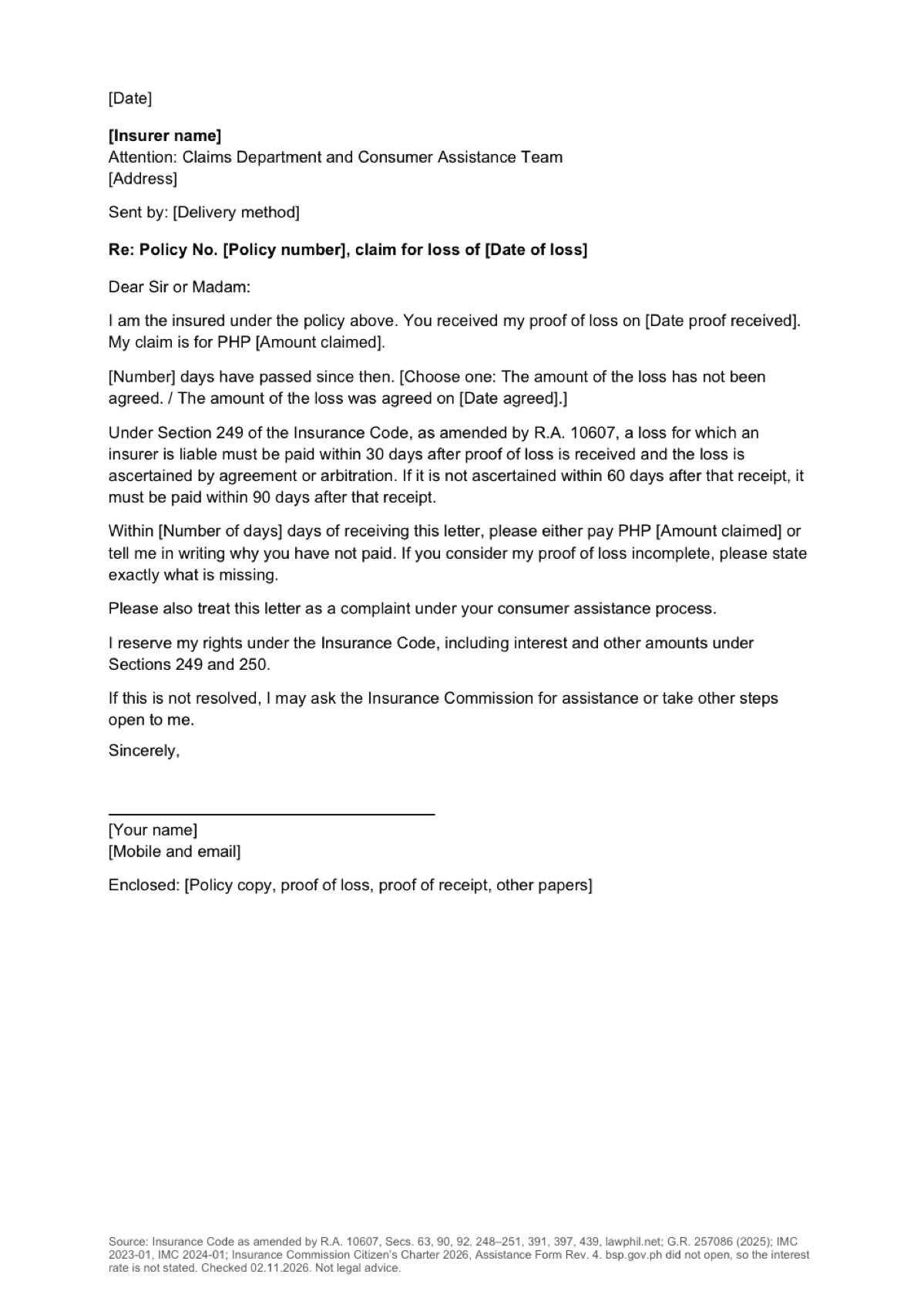
The letter is written. Add your policy, dates and amount.
Insurance claim not paid — send a demand letter
For non-life insurance, a loss the insurer is liable for must be paid within 30 days after it receives proof of loss and the loss is ascertained by agreement or arbitration. If that has not happened within 60 days of receipt, it must be paid within 90 days of receipt. Late payment carries interest at twice the ceiling set by the Monetary Board, unless the refusal is based on the ground that the claim is fraudulent.
Updated: · Next check 2027-02-02
We will ask you to confirm this address, then email you the recipient’s reply.
Start typing right in the document — no sign-up. It stays in this browser; save it to your free Layers account to keep it, open it on your phone and share it.
Enter a date — we’ll count the deadlines
- Amount not agreed: day 90type the date
Layers never asks for a code or payment in a message.
Check your own case.
Insurance Code, Sec. 249. If the amount was agreed, count 30 days from the later of receipt and agreement.

Liza, Layers template assistant
Note the date the insurer received your proof of loss. Every count starts there.
Ask for any refusal in writing: you will need it.
Deadlines
The rules, with the source
| What | Deadline | Source |
|---|---|---|
| Time limit, non-life | 30 days after proof of loss is received and the loss is ascertained by agreement or by arbitration | Insurance Code as amended by R.A. 10607, Sec. 249 |
| Amount not ascertained | Not ascertained within 60 days of receiving proof of loss: pay within 90 days of that receipt | Sec. 249 |
| Life | Policy maturing by death: within 60 days after the claim is presented and proof of death is filed | Sec. 248 |
| Late payment | Interest for the delay at twice the ceiling set by the Monetary Board, unless the refusal is based on the ground that the claim is fraudulent | Secs. 248, 249 |
| Unreasonable denial | In a case, the Commissioner or court decides if payment was unreasonably denied or withheld. Then the insurer pays attorney’s fees, expenses and that interest. Not paying within the time limit is prima facie evidence of unreasonable delay | Sec. 250 |
| Notice of loss | Fire: give written notice without unnecessary delay, or the insurer is exonerated. For other non-life insurance the Commissioner may set the period | Sec. 90 |
| Time to sue | A clause that limits your time to sue to under 1 year from when the cause of action accrues is void. The Supreme Court counts this from the insurer’s rejection of the claim. Asking it to reconsider does not stop the clock | Sec. 63; G.R. No. 257086 (2025) |
| Where to complain | The Insurance Commissioner can decide claims of up to ₱5,000,000 per claim, excluding interest, costs and attorney’s fees. You can go to the Commission or the courts, but filing with the Commission bars a court case on the same matter | Sec. 439 |
| How to ask for help | Assistance Form or a complaint letter: by mail, in person at the Main Office or a District Office, or to publicassistance@insurance.gov.ph | Assistance Form Rev. 4; Citizen’s Charter 2026 |
| What to attach | Non-life or life: policy copy, denial letter if any, supporting documents if any | Assistance Form Rev. 4; IMC 2023-01, Rule VIII, Sec. 4 |
| Mediation | Mediation at the Commission is optional, and it is free. You can go straight to a formal claim. A formal claim is a Statement of Claims (up to ₱1,000,000) or a verified complaint, with a certificate of non-forum shopping and a docket fee. Keep any written denial | IMC 2023-01, Rule VIII, Sec. 2; Citizen’s Charter 2026 |
| Motor (CTPL) | Compulsory motor cover has its own rules: up to ₱30,000 per person is paid without proving fault, written notice is due within 6 months of the accident, and any case must be filed within 1 year of denial | Secs. 391, 397; IMC 2024-01 |
bsp.gov.ph did not open, so the interest rate is not stated here.
What does not exist
Be careful with these.
- “The insurer is late after 30 days, whatever happens”: Without an agreed amount, the insurer is not late before day 90 after it received your proof of loss.
- “You must try mediation first”: Mediation at the Commission is optional. You can go straight to a formal claim.
Step by step
What to do, in order
1
Find your papers
Your policy and the proof of loss you gave. Note the date the insurer received it.
2
Work out your date
Amount agreed: 30 days. Not agreed within 60 days of receipt: day 90 after the insurer received your proof of loss. Before that date the insurer is not late.
3
Fill in the letter
Policy number, date of loss, amount, date of proof of loss.
4
Send it
In a way that keeps proof of receipt.
5
No answer, or a refusal?
Ask the Insurance Commission for assistance. Check your policy’s time limit to sue: a refusal can start it.
Questions
How long does an insurer have to pay?
Non-life: 30 days after proof of loss is received and the loss is ascertained by agreement or arbitration. If not ascertained within 60 days of receipt, within 90 days of receipt.
Must I go to mediation first?
No. Mediation at the Commission is optional and free. You can go straight to a formal claim.
Can I go to both the Commission and the court?
You can choose either, but filing with the Commission bars a court case on the same matter.
How long do I have to sue?
Check your policy. A clause giving under 1 year from when the cause of action accrues is void. The Supreme Court counts from the insurer’s rejection.
Is this letter enough to get paid?
It does not guarantee payment. Your policy wording and the facts decide your case.
Official sources
Other documents
Keep the papers in one place
Letters, receipts and notices in one folder you can share with family or a lawyer. The templates and the editor are free; Layers is free for up to 20 people.
This is general information and a template, not legal advice. Sending it does not guarantee payment. Your policy wording and the facts decide your case. Claim only what is true: presenting a fraudulent claim is an offence (Sec. 251).