 Jira & Confluence




 Bitrix24
Bangladesh · Right to Information Act, 2009 · sections 8, 9 and 24
Office not answering about your file? — RTI application ready, deadlines counted
Short answer. Your application to the Designated Officer is open below: list exactly what information you need. Information to be given: Within 20 working days of receiving the request (Right to Information Act, 2009, section 9(1)).
- Refusal must be told to you by about (10 working days = 2 calendar weeks, later if there are public holidays): type the date
- Information due by about (20 working days = 4 calendar weeks, later if there are public holidays): type the date
- If more than one unit or authority is involved: due by about (30 working days = 6 calendar weeks): type the date
- If this is instead the date the time limit ended or you got the decision: last day to appeal (30 days): type the date
Check your own case.
The Designated Officer must give the information within 20 working days of receiving the request, or 30 working days if more than one unit or authority is involved; if unable to give it, must tell you the reasons within 10 working days; information about life or death, arrest or release from jail — preliminary information within 24 hours (Right to Information Act, 2009, section 9(1)–(4)). You may appeal within 30 days after the time limit passes or after receiving the decision (section 24(1)). We convert working days into calendar weeks (five working days a week); public holidays push the real date later.
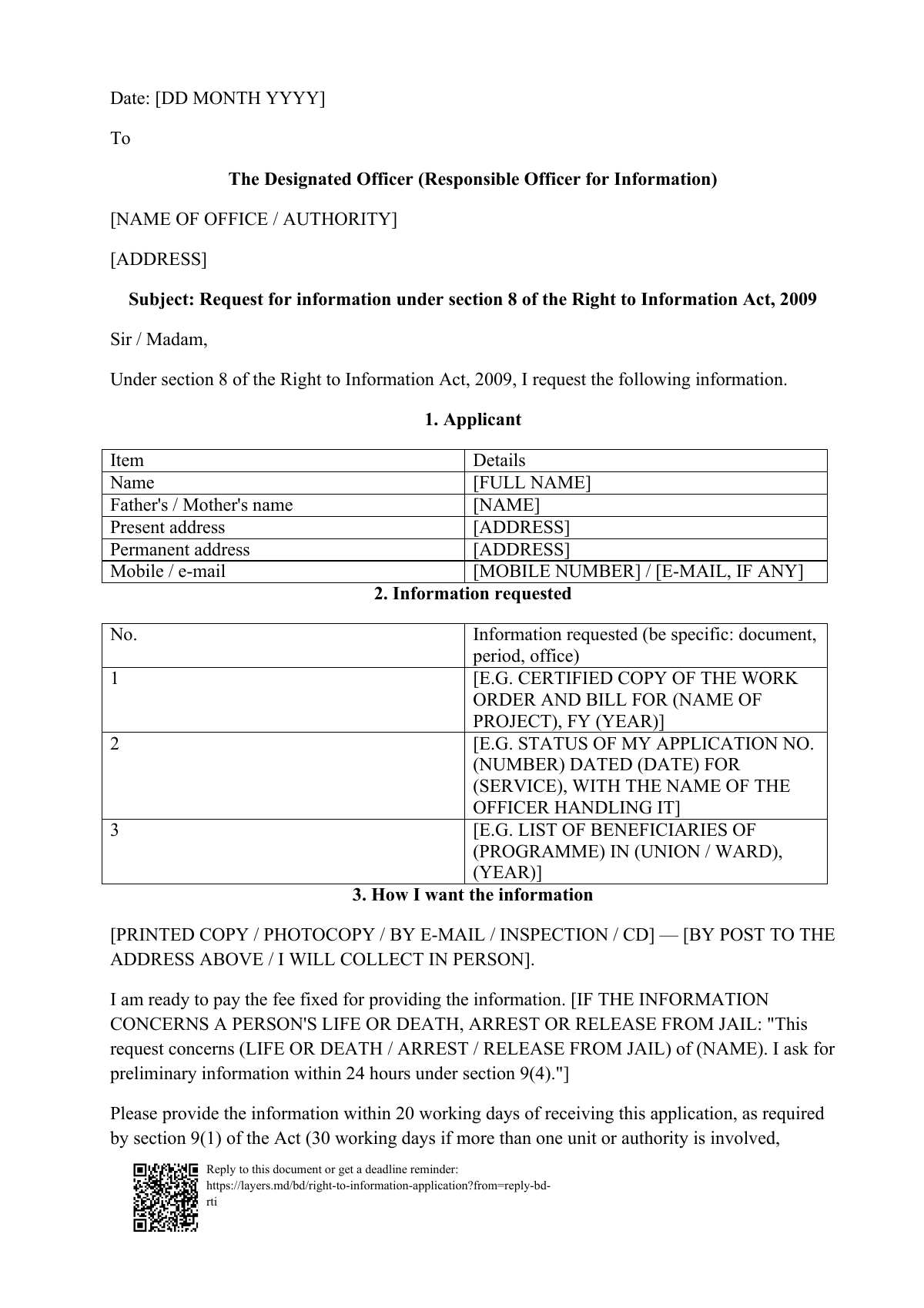
Start typing right in the document — no sign-up. It stays in this browser; save it to your free Layers account to keep it, open it on your phone and share it.

Meera, Layers template assistant
Give me the date on your received copy, and I will show you when the answer is due and from when you can appeal.
Ask for one specific document per line. It is harder for the office to say the request is unclear.
An illustrated character, not a lawyer.
Deadlines
The rules, with the source
| What | Deadline | Source |
|---|---|---|
| Information to be given | Within 20 working days of receiving the request | Right to Information Act, 2009, section 9(1) |
| More than one unit or authority involved | Within 30 working days | Section 9(2) |
| If the officer cannot give it | Reasons in writing within 10 working days of receiving the application | Section 9(3) |
| Life or death, arrest, release from jail | Preliminary information within 24 hours | Section 9(4) |
| Appeal | Within 30 days after the time limit passes or the decision is received; late appeal may be accepted for reasonable cause | Section 24(1)–(2) |
| Decision on appeal | Within 15 days of receiving the appeal: order the information to be given, or reject the appeal | Section 24(3) |
Count from the date on your received copy. Keep the copy safe: it is your proof for the appeal.
Step by step
What to do, in order
1
Find the Designated Officer
Every public office has one; the name is often on the office notice board or website.
2
Write exactly what you need
Name the document, the period and the office. Vague questions get vague answers.
3
Choose the format
Photocopy, printed copy, e-mail or inspection.
4
Submit and get a received copy
By hand with a seal and date, or by post with acknowledgement.
5
Check the due date
Enter the received date above: about 4 weeks for the answer.
6
Appeal if needed
No answer or refusal? Appeal to the appellate authority within 30 days.
Questions
How long does the office have to give me the information?
20 working days from receiving your application, or 30 working days if more than one unit or authority is involved. If the officer cannot give it, the reasons must be given within 10 working days.
What if I get no answer?
You can appeal to the appellate authority within 30 days after the time limit passes. The appellate authority must decide within 15 days.
Do I have to use the official form?
Use the office's form if it has one. Where the form is not available, a written application with the same particulars is commonly accepted; ask for a received copy either way.
Official sources
Other documents
Keep the papers in one place
Letters, receipts and notices in one folder you can share with family or a lawyer. The templates and the editor are free; Layers is free for up to 20 people.
This is a ready document and a deadline calculation, not legal advice.