 Jira & Confluence




 Bitrix24
Bangladesh · Negotiable Instruments Act, 1881 · sections 138 and 141
Cheque returned unpaid? — section 138 legal notice ready, all three deadlines counted
Short answer. The legal notice to the drawer is open below: fill in the cheque, the bank's dishonour and the amount. Presenting the cheque: Within six months of its date or within its validity, whichever is earlier (Negotiable Instruments Act, 1881, s.138(1), proviso (a)).
- Last day to send the written legal notice to the drawer (30 days): type the date
- If this is instead the date the drawer received your notice: the drawer's 30 days to pay end on: type the date
- If this is instead the first day after the drawer's 30 days ended (cause of action): last day to file the complaint (one month): type the date
- If this is instead the date written on the cheque: present it to the bank before this date (six months, or earlier if its validity is shorter): type the date
Check your own case.
The notice must be given within thirty days of receiving the bank's information about the dishonour; the drawer then has thirty days from receiving the notice to pay (Negotiable Instruments Act, 1881, section 138(1), proviso (b)–(c)). A complaint must be made within one month of the date the cause of action arises under proviso (c) (section 141(b)). The cheque must have been presented within six months of its date or within its validity, whichever is earlier (proviso (a)). Count from the actual dates on your bank slip and postal AD card.
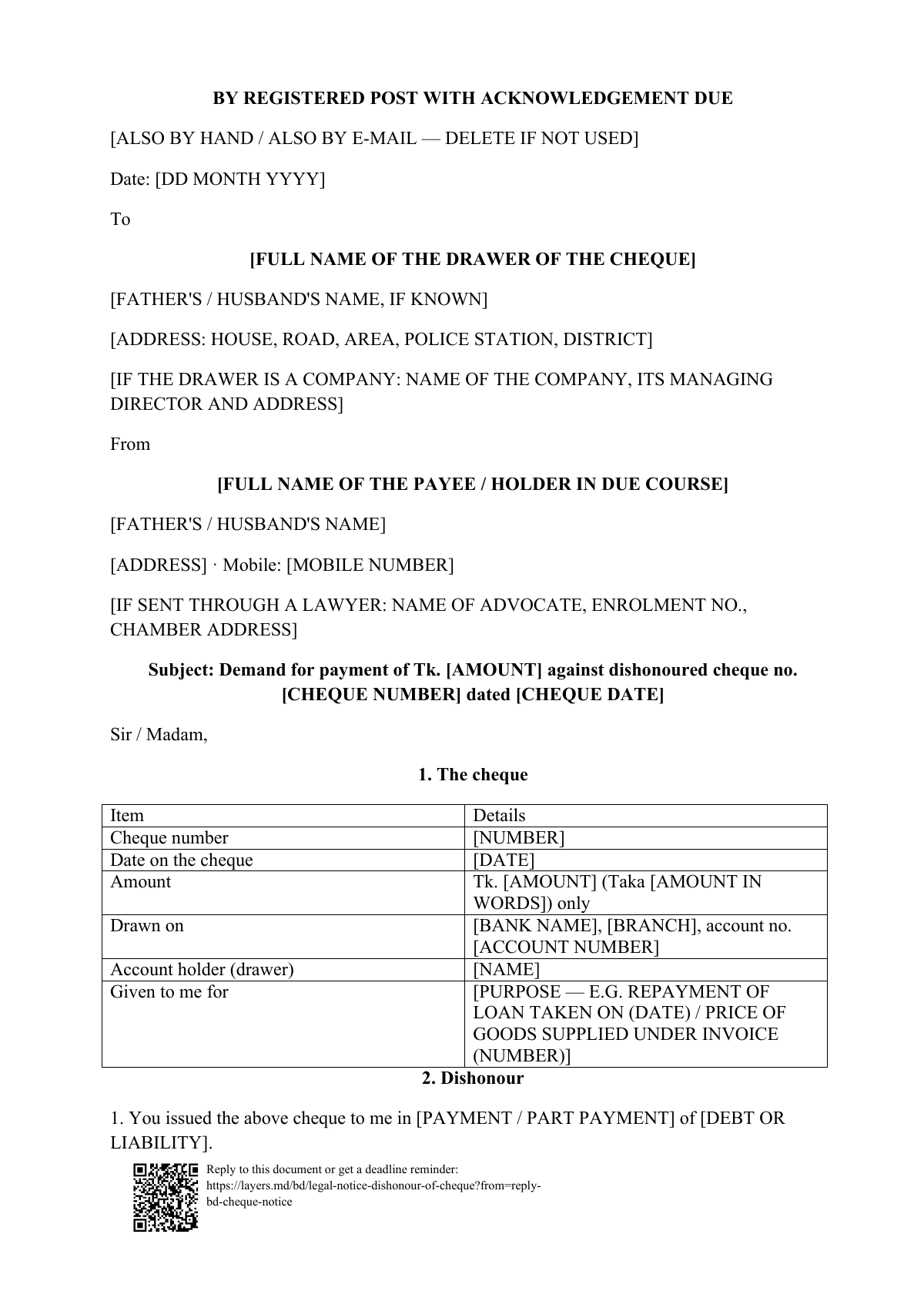
Start typing right in the document — no sign-up. It stays in this browser; save it to your free Layers account to keep it, open it on your phone and share it.

Meera, Layers template assistant
Give me the date your bank told you the cheque bounced, and I will show you the last day to send the notice.
Write the amount in figures and in words, exactly as on the cheque. Mismatches are the first thing the other side looks for.
An illustrated character, not a lawyer.
Deadlines
The rules, with the source
| What | Deadline | Source |
|---|---|---|
| Presenting the cheque | Within six months of its date or within its validity, whichever is earlier | Negotiable Instruments Act, 1881, s.138(1), proviso (a) |
| Legal notice to the drawer | In writing, within thirty days of receiving the bank's information of dishonour | s.138(1), proviso (b) |
| Drawer's time to pay | Thirty days from receiving the notice | s.138(1), proviso (c) |
| How the notice is served | By hand; by registered post with acknowledgement due to the usual or last known address; or by publication in a widely circulated daily Bangla national newspaper | s.138(1A) |
| Filing the complaint | In writing, within one month of the date the cause of action arises | s.141(a)–(b) |
| Punishment and civil claim | Up to one year's imprisonment, or fine up to three times the cheque amount, or both; the right to a civil claim is kept | s.138(1), (2), (3) |
The deadlines are strict: a notice or complaint outside them can defeat the case. Keep the dishonour slip, the postal receipt and the AD card.
Step by step
What to do, in order
1
Get the dishonour slip
Ask your bank for the return memo with the reason and the date.
2
Count your 30 days
Enter the date you got the bank's information above.
3
Fill in the notice
Cheque number, date, amount in figures and words, bank and branch, purpose.
4
Send it the right way
Registered post with AD to the drawer's address, or by hand with a signed receipt.
5
Wait 30 days from receipt
Use the date on the AD card. The drawer may pay in this time.
6
File within one month
If unpaid, file the complaint in court within one month after the 30 days end. A lawyer usually files it.
Questions
From when do I count the 30 days for the notice?
From the day you received the bank's information that the cheque was returned unpaid, not from the date on the cheque.
Can I send the notice by e-mail or WhatsApp only?
The Act lists three ways: by hand, by registered post with acknowledgement due, or by newspaper publication. Use one of them; an e-mail can be an extra copy.
Do I need a lawyer to send the notice?
The Act requires a written notice from the payee or holder; it does not require a lawyer. Many people use an advocate to file the complaint in court.
Official sources
Other documents
Keep the papers in one place
Letters, receipts and notices in one folder you can share with family or a lawyer. The templates and the editor are free; Layers is free for up to 20 people.
This is a ready document and a deadline calculation, not legal advice.