 Jira & Confluence




 Bitrix24
Singapore · Employment Act ss.26–28 · TADM: 1 year, or 6 months after you leave
Pay docked for coming late in Singapore? — dispute letter ready, TADM deadline counted
Short answer. Your letter to the employer is open below: list each late day, the minutes and the amount taken. No unauthorised deductions: Only deductions authorised by the Act (or by court order and certain government agencies) (Employment Act 1968, s.26).
- Still working there: last day to submit a mediation request to TADM (1 year after the date you entered): type the date
- Already left (enter your last day of employment): last day to submit to TADM (6 months): type the date
- If you entered the last day of a salary period: latest day your salary must be paid (before the 7th day after it ends): type the date
Check your own case.
Employment Claims Act 2016 s.3(2): a mediation request must be submitted not later than one year after the date on which the material facts occurred, or, where the employment has ended, not later than 6 months after the last day of employment. Employment Act 1968 s.21(1): salary must be paid before the expiry of the 7th day after the last day of the salary period. Choose the rule that fits your situation; submit well before the date shown.
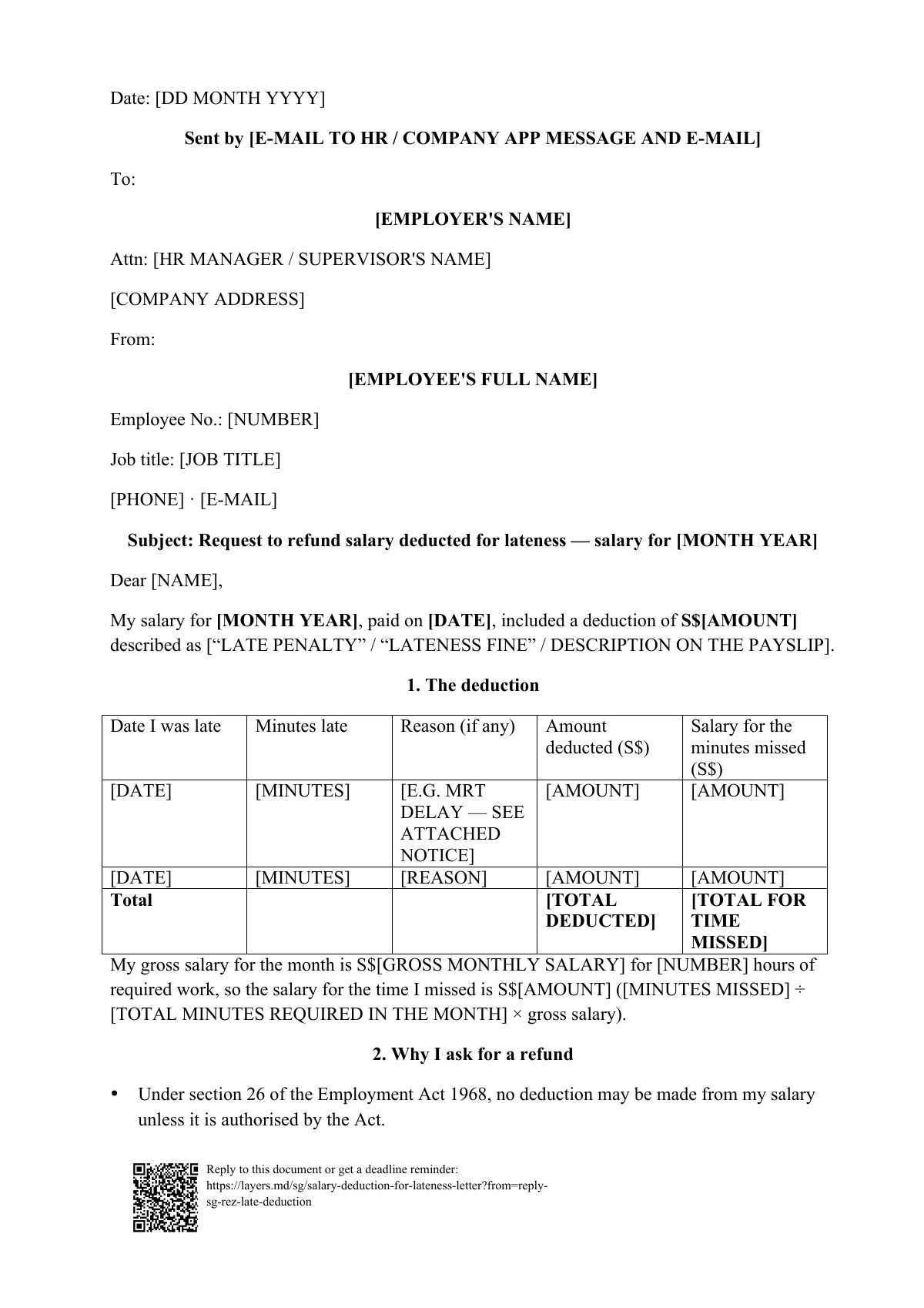
Start typing right in the document — no sign-up. It stays in this browser; save it to your free Layers account to keep it, open it on your phone and share it.

Lida, Layers template assistant
Enter the date of the payslip with the deduction, and I will show you the last day to file at TADM.
List each late day separately — minutes, amount taken, and what the minutes are really worth.
An illustrated character, not a lawyer.
Deadlines
The rules, with the source
| What | Deadline | Source |
|---|---|---|
| No unauthorised deductions | Only deductions authorised by the Act (or by court order and certain government agencies) | Employment Act 1968, s.26 |
| Deduction for absence | Allowed, but not larger in proportion than the time absent | Employment Act 1968, s.27(1)(a), s.28(2) |
| MOM guidance on lateness | If you were 30 minutes late, only 30 minutes' salary can be deducted; excessive deductions can be taken to TADM | MOM (ask.gov.sg), 'Can my employer deduct my pay for coming late to work?' |
| Limit on total deductions | Not more than 50% of the salary for the period (some types excluded, e.g. absence) | Employment Act 1968, s.32 |
| TADM time limit — still employed | Not later than 1 year after the material facts | Employment Claims Act 2016, s.3(2)(g) |
| TADM time limit — employment ended | Not later than 6 months after the last day of employment | Employment Claims Act 2016, s.3(2)(f) |
Deductions you agreed to in writing are also allowed by the Act (s.27(1)(i)). This letter is strongest where you did not consent in writing to a fixed lateness charge.
Step by step
What to do, in order
1
Collect the payslips
Mark every line where money was taken for lateness.
2
Count the minutes
Use your clock-in records. Work out the salary for those minutes only.
3
Fill in the table
Deducted amount vs. salary for the time missed. The difference is your claim.
4
Send to HR
By e-mail, so you have a dated record. Ask for a reply within 7 days.
5
No reply?
Submit a mediation request to TADM before the deadline shown above.
Questions
Is my employer allowed to deduct anything for lateness?
Yes, for the time you were actually absent. MOM's example: 30 minutes late, 30 minutes' salary.
The handbook says S$5 per late arrival. Does that make it legal?
Not by itself. A deduction must be authorised by the Employment Act. If you signed a written consent to such a charge, the position is different — get advice.
Will I get into trouble for writing this letter?
MOM's guidelines treat dismissal for exercising an employment right as wrongful. Keep your letter polite and factual.
Official sources
Other documents
Keep the papers in one place
Letters, receipts and notices in one folder you can share with family or a lawyer. The templates and the editor are free; Layers is free for up to 20 people.
This is a ready document and a deadline calculation, not legal advice.